Miniature Dachshund Feeding Chart by Age and Weight
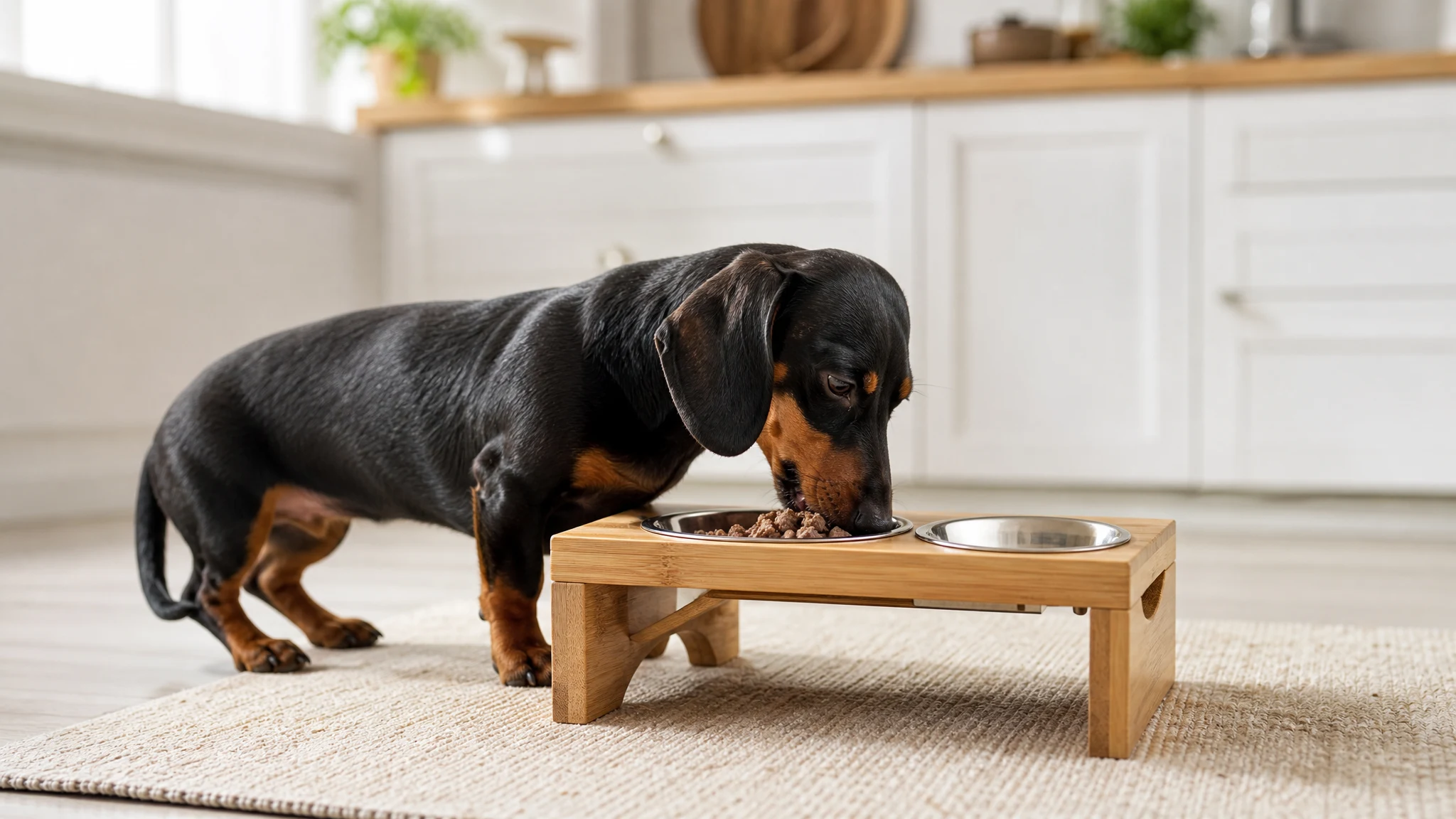
General nutrition information compiled from product labels and published sources, not veterinary advice. Your veterinarian is the right person to choose a diet for your dog, especially one with a health condition.
A miniature dachshund feeding chart sounds simple, but no single chart fits every dog. Two Miniatures of the same age can need different amounts because of activity, build and the food in the bowl. This guide shows you how to build your own chart from the feeding guide on your dog's food label, then adjust it by watching your dog's body.
The amounts here are starting points, not prescriptions. For the broader picture, see our Dachshund feeding chart by age and weight.
How we compared the numbers
We compared label data published by the brands: calories per cup, guaranteed analysis, ingredient order and the feeding table. We did not run feeding trials or taste tests. Treat every number below as what the label says, not as a result we observed in a dog.
What a Miniature Dachshund weighs
The Dachshund Club of America breed standard places Miniatures in the 11 pounds and under class at 12 months of age and older. Standards usually run 16 to 32 pounds. Both sizes count as small dogs, well under the 70 pound line that AAFCO uses for large-size dogs.
Many pet Miniatures drift above 11 pounds, and that is where feeding gets tricky. Check with your veterinarian about the weight that suits your dog's frame.
Materials you will need
- A standard 8 ounce dry measuring cup, or a kitchen scale that reads in grams
- The bag or can of your dog's current food, with its feeding table and calorie statement
- A bathroom scale or pet scale to track weight
- A notebook or phone note for a weekly weight and body check log
- Your veterinarian's phone number, for questions about amounts
Step 1: Weigh your dog and note the life stage
Weigh your dog today. Hold your dog and step on a scale, then subtract your own weight, or use a pet scale. Write down the number and your dog's age in months.
Life stage matters because puppy and adult foods are built differently. PetMD gives general small-breed guidance that dogs under about 25 pounds as adults reach adult size at 10 to 12 months. It says they may be ready for adult food around 9 to 10 months. That is general small-breed guidance, not Dachshund-specific. Tufts advises that no puppy of any size move to adult food before 12 months. Ask your veterinarian to confirm the timing for your dog.
Step 2: Find the feeding table on your food's label
Every complete and balanced food has its own feeding guide, because calories per cup vary a lot. A cup of one food can have far more calories than a cup of another, so a chart copied from a different brand can be wrong for yours.
Here is how the label data compares for some foods with small-dog or Dachshund-specific labeling:
| Food (brand page) | Life stage | Calories per cup (label) |
|---|---|---|
| Royal Canin Dachshund Puppy, dry | Puppy, 8 weeks to 10 months | 369 kcal ME |
| Royal Canin Dachshund Adult, dry | Adult, 10 months and older | 293 kcal ME |
| Hill's Science Diet Puppy Small & Mini | Puppy | 418 kcal |
| Hill's Science Diet Adult Small Bites | Adult | 365 kcal |
| VICTOR Hi-Pro Plus Small Breed Adult | All life stages except large-size growth | 360 kcal |
| Freshpet Small Dog Bite Size Chicken | All life stages except large-size growth | 267 kcal ME |
The spread is wide, from 267 to 418 calories per cup. Feeding the same cup of each would give very different daily energy. This is why the label table for your own food is the one to follow.
Step 3: Read the starting amount for your dog's weight
Find your dog's current weight in the table. Puppy tables usually go by age and expected adult weight. Adult tables usually go by body weight and sometimes activity level.
A few examples from brand pages show how different the guides are:
- Royal Canin's Dachshund Puppy page lists 5/8 cup (67 g) per day for a 2-month-old puppy with a 6.6 pound target adult weight.
- Hill's lists 5/8 cup per day for a 5 pound dog on its Adult Small Bites page.
- Freshpet's page example shows 1 to 1 1/4 cups per day for an 11 to 15 pound dog.
These are examples from different foods with different calorie counts. Do not mix them into one chart. Use only the table for the food in your bowl.
The Royal Canin Dachshund Adult and canned pages also have feeding tables by weight and activity level. The VICTOR small and medium breed puppy page suggests feeding as much as the puppy will eat in 20 minutes, in 4 feeding intervals through the day. VICTOR's adult page says that after age one you should feed to maintain good body condition, using the chart as a guide.
Step 4: Split the daily amount into meals
Divide the daily total into measured meals. The VICTOR puppy label points to 4 feedings a day for a young puppy. The other brand pages in our comparison do not state a meal count, so ask your veterinarian how many meals suit your dog's age.
Measure each meal with the same cup or scale every time. Scooping by eye is a common way for portions to creep up.
Step 5: Add up treats and extras
Treats, chews and table scraps count. If your dog gets treats, take a little away from the meals. Use small pieces of treats, and consider using part of the regular kibble as training rewards.
Step 6: Check the body, not just the cup
Every five to seven days, weigh your dog and look at the body from above and from the side. You should be able to feel the ribs under a light covering of fat, and you should see a waist from above. Hill's tells owners to adjust amounts as necessary to maintain optimal weight, and that is the right idea for any food.
This matters for Dachshunds in particular. PetMD says the breed is predisposed to obesity and that extra weight raises the risk of back injury. A review of Hansen type I disc disease in PubMed Central notes Miniature Dachshunds are over-represented in that condition and discusses obesity as a possible but unproven risk factor. Dachshund Health UK says research on weight and disc disease is mixed, but it still advises keeping Dachshunds lean. Food does not treat or cure disc disease, and your veterinarian decides what is right for your individual dog.
Step 7: Adjust slowly and write it down
If your dog is gaining and the ribs are hard to feel, trim the daily amount a little and recheck in a couple of weeks. If your dog looks thin or low on energy, call your veterinarian before adding food. Small, steady changes are easier to judge than big ones.
When you change foods, mix the new food in gradually over several days, unless your veterinarian says otherwise.
Tips for a more accurate chart
- Use the calories per cup on the label to compare foods before you switch. A food with fewer calories per cup needs a bigger scoop for the same energy.
- Look for an AAFCO statement. Foods labeled for growth or all life stages must say whether they include or exclude growth of large-size dogs (70 pounds or more as an adult). Tufts notes the calcium range is narrower for large and giant breed puppies. A Dachshund is not a large-size dog, so an "except for" statement is acceptable for them.
- Keep activity in mind. Tables that include activity level reflect that a busy dog burns more than a sofa-loving one.
- Re-weigh after any illness, spay or neuter, or change in routine.
Common mistakes to avoid
- Copying another dog's chart. Calories per cup differ widely between foods.
- Leaving food out all day. It makes portions hard to track.
- Ignoring treats. They can add up quickly for a dog this small.
- Switching to adult food too early. Confirm timing with your veterinarian rather than relying on a general rule.
- Using a puppy chart for an adult. Puppy foods tend to carry more calories per cup.
- Treating a chart as a rule. It is only a starting point.
What to expect
If you measure meals and track weight, many owners find their dog's weight settles into a steady range within a few weeks. Results vary with age, activity and health, and no chart can promise a particular outcome. A lean, steady body is a reasonable goal to discuss with your veterinarian.
Confirm amounts with your veterinarian if your dog has a health condition, such as back problems, weight trouble, a food allergy or heart concerns. Prescription diets are something only a veterinarian prescribes. On the topic of grain-free and heart disease, the FDA's last public update on its investigation into diets and canine dilated cardiomyopathy was December 23, 2022. It does not plan more public updates until there is meaningful new science. Ask your veterinarian if you have questions about your dog's diet.
The Dachshund growth timeline, such as how fast a Miniature puppy should gain, was not available from a breed club source. Ask your veterinarian or the Dachshund Club of America for a growth reference.
Sources
- Dachshund Club of America, breed standard
- PetMD, Dachshund Dog Breed Health and Care
- PetMD, When Should You Switch From Puppy to Adult Dog Food
- PubMed Central, Canine chondrodystrophic intervertebral disc disease (Hansen type I disc disease)
- Dachshund Health UK, Body Condition
- Tufts Cummings School, Petfoodology
- FDA CVM, Investigation into Potential Link between Certain Diets and Canine Dilated Cardiomyopathy
- Royal Canin, Dachshund Adult
- Hill's Science Diet, Adult Small Bites
- VICTOR, Hi-Pro Plus Small & Medium Breed Puppy