How Much to Feed a Dachshund: Feeding Chart by Age and Weight
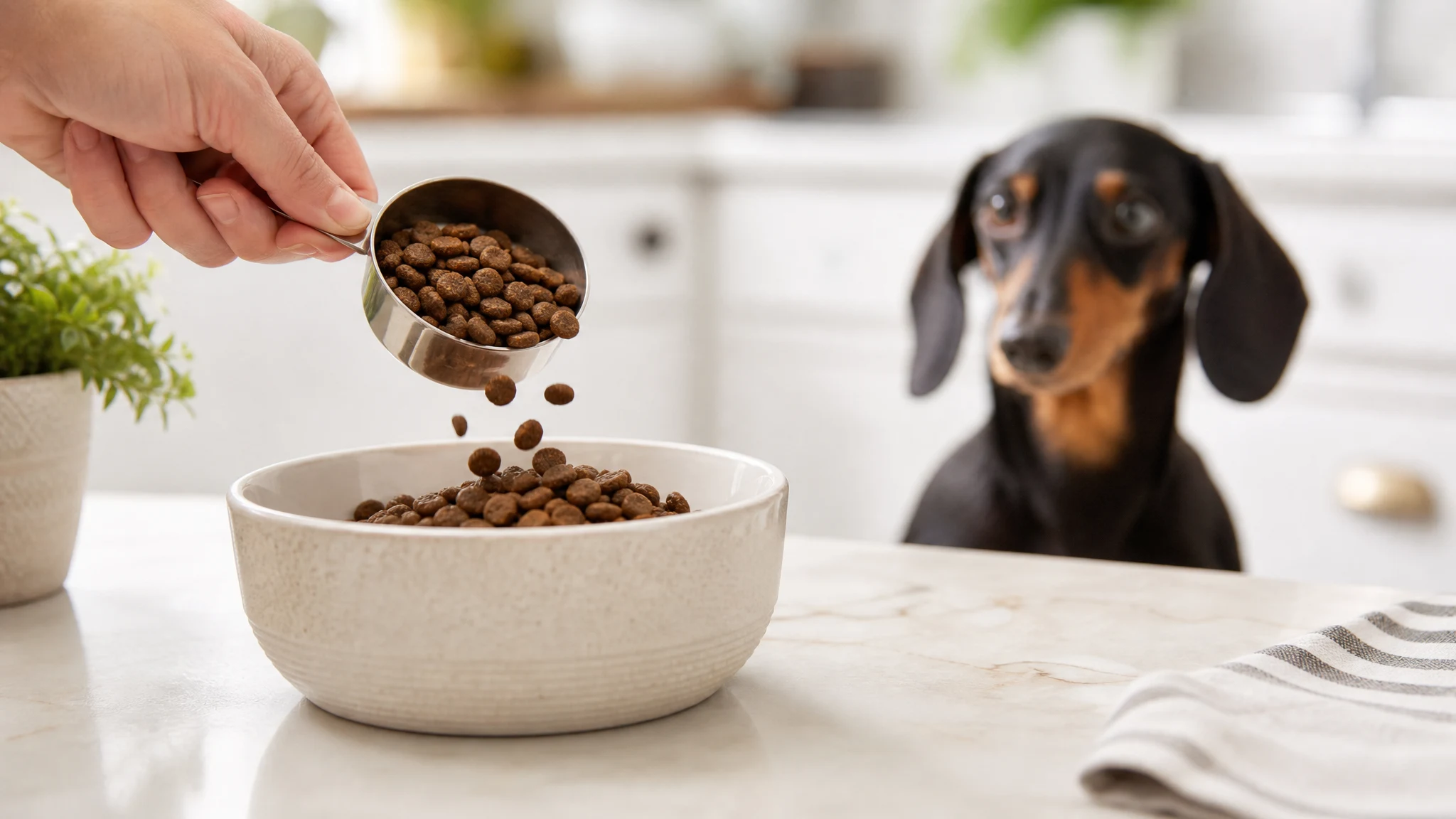
General nutrition information compiled from product labels and published sources, not veterinary advice. Your veterinarian is the right person to choose a diet for your dog, especially one with a health condition.
Owners often ask how much a Dachshund should eat in a day. The honest answer is that no single number fits every dog. A 9-pound miniature and a 28-pound standard need very different amounts. Two dogs of the same weight can also differ with age, activity and metabolism.
This guide shows how to find a sensible starting amount from the food's own label, then adjust it by watching your dog's body. The chart below uses real label figures from several foods. It is a set of starting points, not a prescription. A veterinarian sets the amount for an individual dog.
Why portions matter more for this breed
PetMD describes Dachshunds as predisposed to obesity, and says extra weight raises the risk of back injury. The back is the concern because the breed is prone to intervertebral disc disease (IVDD). PetMD states that as many as 25% of Dachshunds develop IVDD in their lifetime.
The science on weight and IVDD is mixed, and it is worth saying so. A review of Hansen type I disc disease on PubMed Central notes that miniature Dachshunds are over-represented and discusses obesity as a possible but unproven risk factor. Dachshund Health UK, an IVDD charity, cites research linking heavier dogs to IVDD but says its own 2015 survey did not repeat that finding. It still advises keeping Dachshunds lean.
No feeding plan prevents or treats back disease. Keeping a dog lean is a sensible habit, and your veterinarian can tell you what it means for your dog.
What you need
- The bag, can or tray label for your dog's food, or the brand's product page.
- A level measuring cup. A kitchen scale that weighs in grams is even better.
- A scale to weigh your dog. A bathroom scale works: weigh yourself, then yourself holding the dog, and subtract.
- A notebook or phone note for weights and daily amounts.
- Your veterinarian's phone number for questions about growth, weight loss and medical issues.
Know your Dachshund's size
The Dachshund Club of America breed standard describes two sizes. Standard Dachshunds usually weigh 16 to 32 pounds. Miniatures compete in the 11 pounds and under class at 12 months of age and older.
Both sizes count as small dogs. The AAFCO line for large-size dogs is 70 pounds or more as an adult, and Dachshunds are well under it. That matters when you read puppy food labels, covered below.
Many pet Dachshunds fall between the two show sizes. If yours is 12 to 15 pounds, do not assume either set of numbers applies. Use the actual weight on your scale.
Step 1: Pick a complete and balanced food and read the statement
Find the AAFCO nutritional adequacy statement on the label. It should say the food is complete and balanced for your dog's life stage, such as growth, maintenance or all life stages.
For a Dachshund puppy, the label wording about large-size dogs is worth a look. Tufts Cummings School's Petfoodology blog notes that AAFCO growth and all-life-stages labels must say either "including growth of large-size dogs (70 lbs or more as an adult)" or "except for growth of large-size dogs." Tufts also notes the calcium range is narrower for large and giant breed puppies. Dachshunds are not large-size dogs, so the "except for" wording is acceptable for them. A growth food that includes large-size dogs is also a normal label statement.
Whichever food you choose, keep to one food while you set the amount. Changing foods and portions together makes it hard to tell what is working.
Step 2: Find the calories and the label's feeding guide
Two cups of two different foods can carry quite different calories. Look for kilocalories per cup, then the feeding table. The table below shows what several brands publish on their own pages. We compared label data only. We did not run feeding trials or taste tests, and we have not fed any of these foods.
| Food (brand page) | Life stage | Calories per cup or can | What the label's feeding guide says |
|---|---|---|---|
| Royal Canin Dachshund Puppy Dry | Puppy, 8 weeks to 10 months | 369 kcal ME per cup | Daily table by puppy age and target adult weight. Example: a 2-month-old with a 6.6 lb target adult weight gets 5/8 cup (67 g) per day. |
| Royal Canin Dachshund Adult Dry | Adult, 10 months and older | 293 kcal ME per cup | Daily table by dog weight and activity level, plus a feeding calculator on the page. |
| Royal Canin Dachshund Adult Loaf in Sauce (canned) | Adult | 79 kcal ME per can | Canned-only table by weight and activity. The first table row looked inconsistent when we read it, so check the brand page before using any amount. |
| Hill's Science Diet Puppy Small & Mini Chicken & Brown Rice | Puppy | 418 kcal per cup | Adjust amounts as necessary to maintain optimal weight. Use the brand's chart for your puppy's age and weight. |
| Hill's Science Diet Adult Small Bites Chicken & Barley | Adult | 365 kcal per cup | The table starts at 5/8 cup per day for a 5 lb dog. Adjust to maintain optimal weight and ask your veterinarian if unsure. |
| Hill's Science Diet Adult 7+ Small Bites Chicken Meal, Barley & Rice | Mature adult, 7 and older | 352 kcal per cup | Adjust to maintain optimal weight. If unsure, ask your veterinarian. |
| Freshpet Small Dog Bite Size Chicken Recipe | All life stages except growth of large-size dogs | 267 kcal per cup (ME) | You select your dog's weight on the page. Example on the page: 11 to 15 lb is 1 to 1 1/4 cups per day. |
| VICTOR Hi-Pro Plus Small Breed Adult | All life stages except growth of large-size dogs | 360 kcal per cup | After age one, feed to maintain good body condition, using the feeding chart as a guide. |
| VICTOR Hi-Pro Plus Small & Medium Breed Puppy | Puppy | 383 kcal per cup | Feed as much as the puppy will eat in 20 minutes, in 4 feeding intervals spaced through the day. |
Notice the spread. An adult cup ranges from 267 to 365 kcal across these foods. Swapping one food for another cup for cup could change calories noticeably. That is why the brand's own chart, not a generic one, is the right starting point.
The table gives only the examples the brands show. Each page has a fuller chart. You can find them on the brand pages for Royal Canin Dachshund Adult, Hill's Science Diet Adult Small Bites, Freshpet Small Dog Bite Size Chicken and VICTOR Hi-Pro Plus Small Breed Adult. Check each brand for current label details, since formulas and charts can change.
Step 3: Match the chart to your dog's age and weight
Here is how the stages generally work for a Dachshund. Timing is general small-breed guidance rather than Dachshund-specific research.
Puppies
Puppy foods are written for growth, and their charts usually use age plus expected adult weight. Royal Canin's Dachshund puppy table, for example, asks for the puppy's age and target adult weight. If you do not know the likely adult weight, ask your breeder or veterinarian. The VICTOR puppy label takes a different approach, with four feeding times a day and a 20 minute limit per meal. Meal counts differ between brands and between vets, so ask yours how often to feed your puppy.
We could not find a Dachshund-specific growth chart from the breed club, so do not treat any age-based number as breed-verified. Weigh your puppy regularly and share the numbers with your veterinarian.
Adolescents: when to switch to adult food
PetMD says small dogs under about 25 pounds as adults reach adult size at 10 to 12 months, and may be ready for adult food at 9 to 10 months. Tufts advises that no puppy of any size go onto adult food before 12 months. The two sources differ, so ask your veterinarian when to switch. Make the change gradually over several days by mixing the new food into the old.
Adults
Use your dog's current weight, not the weight you wish for. If the dog is overweight, ask your veterinarian for a target weight and use that on the chart. The adult charts above then give your first daily total.
Seniors
Some brands make mature adult foods, such as the Hill's 7+ formula in the table. Activity often drops with age, so watch the body condition more closely. Any change in appetite or weight in an older dog is a reason to call your veterinarian.
Step 4: Measure accurately and split the day into meals
A scoop is not a cup. Use a level measuring cup, or weigh food in grams if the label gives grams. Heaping scoops can add far more food than you think, and a Dachshund is small enough that a little extra goes a long way.
Divide the daily total into the number of meals your veterinarian recommends. Count treats, chews, dental sticks and table scraps as part of the day, not on top of it. If you add wet food, reduce the dry amount using the calorie figures on both labels.
Step 5: Check body condition every two weeks
The scale tells you weight. Body condition tells you whether that weight is fat or lean. Dachshund Health UK has a body condition page written for the breed that is worth reading.
At home, check these three things:
- Ribs. Run your hands along the side of the chest. You should feel the ribs under a thin covering without pressing hard. If you must dig for them, the dog may be carrying extra weight.
- Waist from above. Look down at your standing dog. There should be a visible narrowing behind the ribs.
- Tuck from the side. The belly should rise toward the back legs rather than hang level or sag.
Many veterinarians score these signs on a numbered scale. Ask yours to show you your dog's score and what a healthy score looks like. Long, low coats and loose skin can hide shape, so use your hands as well as your eyes.
Step 6: Adjust for activity, then change slowly
Some labels, such as the Royal Canin adult tables, include activity levels. A dog that walks briskly every day may need more than one that mostly naps. Use the activity column as a guide, not a promise.
If body condition suggests your dog is gaining, trim the daily amount a little and recheck in two weeks. If your dog is thin, check with your veterinarian before increasing, since weight loss can have medical causes. Small changes make results easier to read than big ones. Keep the notebook up to date so you can see the trend.
Common mistakes to avoid
- Feeding by the cup without checking calories. Foods vary widely, as the table shows.
- Forgetting treats. Small dogs have small calorie budgets.
- Following the label as a fixed rule. Label guides are starting points for an average dog.
- Switching adult food too early. Confirm the timing with your veterinarian.
- Free-feeding. Leaving food out all day makes intake hard to measure, though the 20 minute puppy guide from VICTOR shows that some labels do call for timed meals.
- Guessing at a medical cause. Sudden weight change, vomiting or back pain call for a veterinary visit, not a new diet.
- Using a diet to manage a condition on your own. Prescription diets are something only a veterinarian prescribes.
What results to expect
If you measure carefully, track weight and adjust slowly, your Dachshund may hold a steadier weight, with ribs you can feel and a visible waist. Results vary by dog. Weight changes are usually gradual, so judge over several weeks rather than a few days.
A lean dog may also be easier on its back, but no food or portion plan can promise protection from IVDD or any other condition. The FDA has also looked at possible links between certain diets and canine dilated cardiomyopathy (DCM). Its page lists a last update of December 23, 2022, and says no further public updates are planned until there is meaningful new science. Diet questions about heart health belong with your veterinarian.
When to call your veterinarian
Call before you change amounts if your dog is a puppy, is pregnant or nursing, is a senior, has back pain or has any health condition. Also call if your dog is losing or gaining weight when you have not changed the food. Your veterinarian can weigh your dog, score body condition and set a daily amount that suits that individual.
Quick recap
- Choose a complete and balanced food and read its AAFCO statement.
- Find calories per cup and the brand's own feeding chart.
- Match the chart to your dog's age and current weight.
- Measure level cups or grams and count treats.
- Check ribs, waist and tuck every two weeks.
- Adjust slowly for activity and confirm every change with your veterinarian.
Sources
- Dachshund Club of America, breed standard
- PetMD, Dachshund Dog Breed Health and Care
- PetMD, When Should You Switch From Puppy to Adult Dog Food
- PubMed Central, Canine chondrodystrophic intervertebral disc disease (Hansen type I disc disease)
- Dachshund Health UK, Body Condition
- Tufts Cummings School, Petfoodology
- FDA CVM, Investigation into Potential Link between Certain Diets and Canine Dilated Cardiomyopathy
- Royal Canin, Dachshund Puppy Dry Dog Food
- Hill's Science Diet, Puppy Small & Mini
- VICTOR, Hi-Pro Plus Small & Medium Breed Puppy