Meal Prep for Dachshunds: Portioning Kibble, Wet and Fresh Food Ahead
General nutrition information compiled from product labels and published sources, not veterinary advice. Your veterinarian is the right person to choose a diet for your dog, especially one with a health condition.
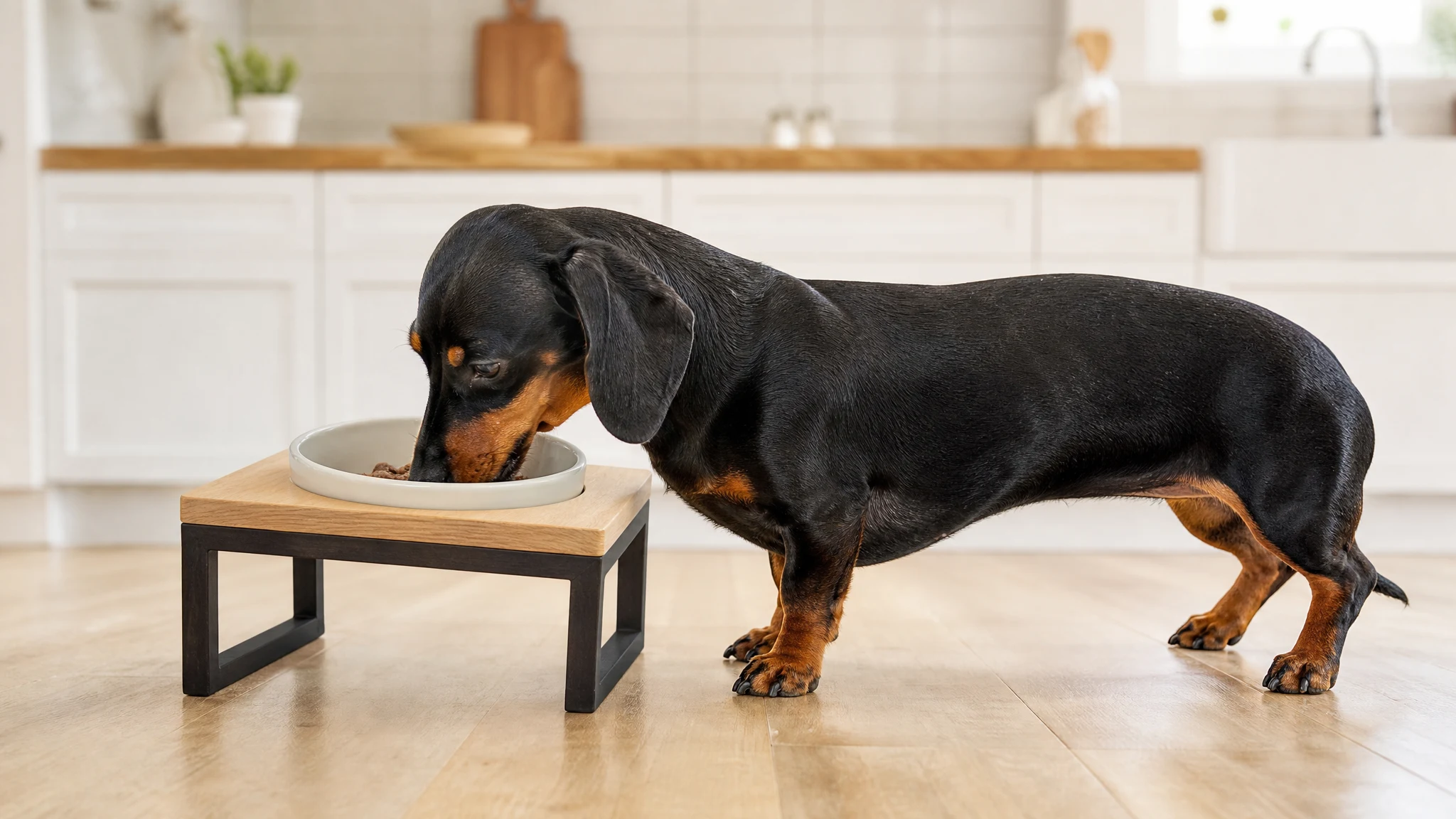
Dog feeding preparation is a small habit that pays off for a long, low dog. A Dachshund is easy to overfeed by a few extra scoops, and those scoops add up fast on a frame this small. Portioning meals ahead of time takes the guesswork out of each feeding.
PetMD describes Dachshunds as predisposed to obesity, and says excess weight raises the risk of back injury. Dachshund Health UK, an IVDD charity, still advises keeping Dachshunds lean, although it notes the research on weight and disc disease is mixed. Measured meals are one practical way to keep daily intake steady.
This guide covers how to portion dry, canned and fresh food in advance. Our comparison method is simple: we read the label data published by each brand. We did not run feeding trials or taste tests.
What You Need
- A kitchen scale that reads in grams (more accurate than a scoop)
- A standard measuring cup, if you also want to see the volume
- Airtight containers or reusable bags, one per meal or per day
- Masking tape and a marker for labels
- The feeding guide from your dog's food bag, can or brand page
- A notepad or phone note for weight checks
- Your veterinarian's advice, especially if your dog has a health condition
Step 1: Find Your Dachshund's Starting Amount
Start with your dog's current weight, age and activity level. According to the Dachshund Club of America breed standard, standard Dachshunds usually weigh 16 to 32 lb. Miniatures compete in the 11 lb and under class at 12 months and older. Your dog may fall outside those ranges, so weigh your own dog.
Then open the feeding table on the food you actually use. Each brand sets its own amounts, and they are starting points, not rules. For a breakdown by age and weight, see our Dachshund feeding chart by age and weight.
Some label examples show how much the guides differ:
- Royal Canin lists 5/8 cup (67 g) per day for a 2-month-old puppy with a 6.6 lb target adult weight on its Dachshund Puppy dry food.
- Hill's Science Diet Adult Small Bites starts its table at 5/8 cup per day for a 5 lb dog.
- Freshpet's page example for an 11 to 15 lb dog is 1 to 1 1/4 cups per day of its Small Dog Bite Size Chicken Recipe.
Write down the daily total in grams or cups, and then the number of meals. Many owners split the day into two meals for an adult. Puppies usually eat more often. VICTOR's puppy page, for example, describes four feedings spaced through the day.
Step 2: Check the Calories, Not Just the Cups
A cup of one food is not a cup of another. The label calorie figures below show why you should never swap foods one-for-one by volume.
| Food (brand label data) | Form | Calories as listed |
|---|---|---|
| Royal Canin Dachshund Adult | Dry | 293 kcal ME per cup |
| Hill's Science Diet Adult Small Bites Chicken & Barley | Dry | 365 kcal per cup |
| VICTOR Hi-Pro Plus Small Breed Adult | Dry | 360 kcal per cup |
| Freshpet Small Dog Bite Size Chicken Recipe | Fresh | 267 kcal per cup |
| Royal Canin Dachshund Adult Loaf in Sauce | Canned | 79 kcal ME per can |
Royal Canin's page does not confirm the can size in the data we reviewed, so check the can in your hand. For a food that is new to you, read the brand's own page for the full label. Hill's lists its protein and fat figures as dry matter averages, so compare those with care.
Step 3: Portion Dry Food (Kibble)
- Set the container on the scale and zero it. This removes the container's weight from the reading.
- Scoop kibble in until you reach the target. Use the grams from the feeding table if the brand gives them. Otherwise measure one cup once, weigh it, and use that gram figure from then on.
- Repeat for each meal. Line up containers for two to three days at a time, or whatever fits your routine.
- Seal and label. Write the date and the meal (for example, "AM" or "PM").
- Store away from heat and moisture. Follow the storage directions printed on the bag.
Weighing matters because kibble packs differently from scoop to scoop. A heaping cup can run well over a level one, and on a 293 kcal cup that is real extra food for a dog under 32 lb.
Step 4: Portion Canned Food
- Work out the share of the daily total. If you feed canned food as a topper or partial meal, decide the split first. A common approach is to count the calories from the can and reduce the dry portion by the same amount.
- Scoop and weigh the open can. Divide it into the number of meals the can will cover.
- Cover and refrigerate leftovers. Use the brand's storage and discard directions.
Check the brand's feeding table before quoting any amount. In the Royal Canin canned-food table we reviewed, the first row (8.8 lb) looked inconsistent, so confirm it on the brand page or with the company before relying on it.
Step 5: Portion Fresh Food
Fresh food usually comes with its own handling rules. Freshpet's Small Dog Bite Size Chicken Recipe lists chicken, chicken liver, carrots, cranberries and eggs as its first five ingredients, and lets you select your dog's weight on the page to see a daily amount.
- Read the brand's storage and handling instructions first. Fresh food has its own time limits, and we are not stating any here. Check the brand.
- Portion on the scale, as with kibble. Divide the daily amount into meals.
- Keep only what you will use soon at the front of the fridge. Follow the brand's directions on freezing, if it allows it.
The Freshpet label says the recipe is formulated for all life stages, with an exception for growth of large-size dogs (70 lb or more as an adult). Tufts Cummings School's Petfoodology blog explains that AAFCO labels carry this wording. Dachshunds are not large-size dogs, so the "except for" wording is acceptable for them. Confirm the exact sentence on the brand's page.
Step 6: Combine Foods Without Doubling Up
If you mix kibble, canned and fresh food, add up the calories from every part of the plate. Each one counts toward the day. Treats and chews also count. A simple method is to set aside a small treat allowance when you do your weekly portioning, so the extras do not sneak on top of full meals.
Step 7: Recheck and Adjust
Weigh your Dachshund on a regular schedule and write the number down. Hill's advises adjusting feeding amounts as necessary to maintain optimal weight. VICTOR suggests that after age one you feed to maintain good body condition, using the chart as a guide.
If your dog is gaining or losing, change the portion slightly and recheck. Ask your veterinarian to show you how to judge body condition by feel.
Tips for Smoother Dog Feeding Preparation
- Portion on the same day each week so it becomes routine.
- Use one scoop for each food, and keep it with that food.
- Keep a printed copy of the daily total on the fridge for everyone in the house.
- Choose a kibble size your dog handles easily. Royal Canin describes its Dachshund kibble as shaped for a pointed muzzle, and Hill's calls its Small Bites kibble small, but neither gives a measurement.
- Transition between foods gradually, and ask your veterinarian how to do it for your dog.
Common Mistakes to Avoid
- Using "a scoop" as a unit. Scoops vary. Weigh at least once to learn what yours holds.
- Swapping foods cup for cup. The table above shows why that changes calories.
- Forgetting the toppers and treats. They can quietly push a small dog past its daily target.
- Moving a puppy to adult food too early. PetMD gives general small-breed guidance of about 9 to 10 months, but Tufts advises that no puppy of any size go onto adult food before 12 months. That guidance is not specific to Dachshunds, so confirm the timing with your veterinarian.
- Treating label amounts as fixed. They are starting points.
- Assuming a breed-specific food is automatically right. Read the ingredients and calories, and ask your vet.
What Results to Expect
Measured meals may help you notice sooner when your dog's weight is drifting. They may also make feeding more consistent between family members. Over several weeks, many owners find it easier to keep a stable weight, although every dog responds differently.
Portioning does not prevent or treat any disease. Intervertebral disc disease is a good example. A review in PubMed Central notes that Miniature Dachshunds are over-represented in Hansen type I disc disease, and describes obesity as a possible but unproven risk factor. PetMD states that as many as 25% of Dachshunds develop IVDD in their lifetime. Diet is only one part of the picture.
If your dog has a health condition, is a puppy, is a senior, or is on a prescription diet, confirm amounts with your veterinarian. Prescription diets are something only a veterinarian prescribes. Do not add supplements to your prepared meals without veterinary guidance.
On grain-free and heart health, the FDA's page on diets and canine dilated cardiomyopathy shows its latest update as December 23, 2022. The agency says it does not intend to release further public updates until there is meaningful new scientific information. Ask your veterinarian about this if you are choosing a food.
Sources
- Dachshund Club of America, breed standard
- PetMD, Dachshund Dog Breed Health and Care
- PetMD, When Should You Switch From Puppy to Adult Dog Food
- PubMed Central, Canine chondrodystrophic intervertebral disc disease (Hansen type I disc disease)
- Dachshund Health UK, Body Condition
- Tufts Cummings School, Petfoodology
- FDA CVM, Investigation into Potential Link between Certain Diets and Canine Dilated Cardiomyopathy
- Royal Canin, Dachshund Adult Dry Dog Food
- Hill's Science Diet, Adult Small Bites
- Freshpet, Small Dog Bite Size Chicken Recipe
- VICTOR, Hi-Pro Plus Small Breed Adult