Feeding Stations for Dachshunds: What to Look for in a Bowl Setup
General nutrition information compiled from product labels and published sources, not veterinary advice. Your veterinarian is the right person to choose a diet for your dog, especially one with a health condition.
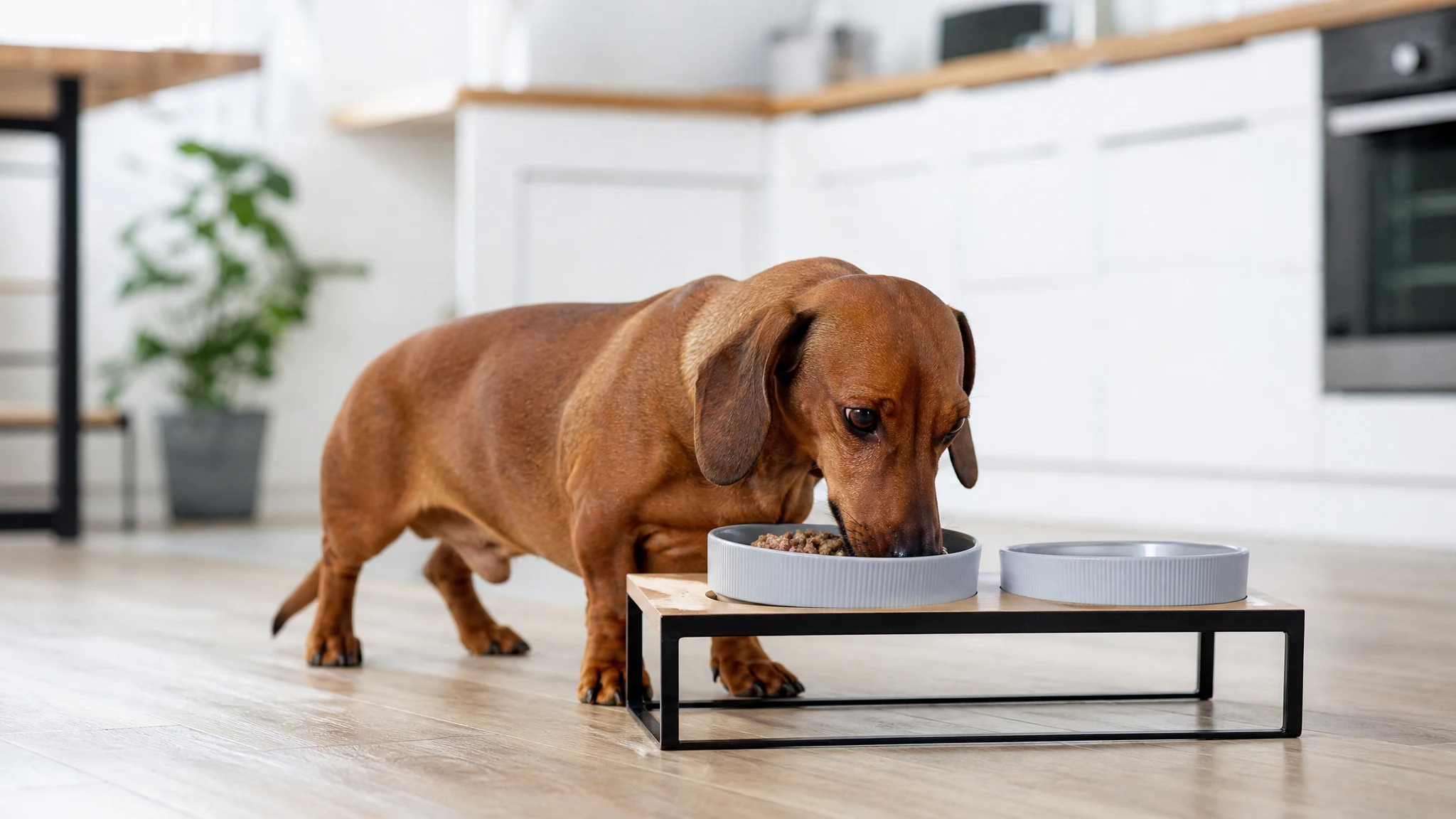
A dog feeding station is just a set place for your dog's bowls, water, mat and measuring tools. For a Dachshund, the setup matters less for looks and more for control. The goal is a steady place to eat, an accurate portion every time, and an easy way to watch body weight.
Weight is the reason this breed gets its own guide. PetMD says Dachshunds are predisposed to obesity and that excess weight raises the risk of back injury. A tidy, repeatable setup makes it harder for extra scoops and stray treats to creep in.
What You Need
- A food bowl sized for a small dog with a long muzzle
- A separate water bowl
- A non-slip mat or tray with a raised edge
- A dry measuring cup or, better, a kitchen scale
- An airtight container for the food, if you buy dry kibble
- A small notebook or phone note for portions and weight checks
- The food's label and feeding guide, kept nearby
You do not need a special product. Plain, stable, easy-to-wash gear does the job.
Step 1: Know Your Dog's Size and Life Stage
Start with the dog, not the bowl. The Dachshund Club of America breed standard describes two sizes. Standard Dachshunds usually weigh 16 to 32 pounds. Miniatures compete in the class of 11 pounds and under at 12 months and older. Both fall well under the 70 pound line AAFCO uses for large-size dogs.
Life stage changes the plan. PetMD gives general small-breed guidance that dogs under about 25 pounds as adults reach adult size at 10 to 12 months. It is general small-breed advice, not specific to Dachshunds. Tufts advises that no puppy of any size move to adult food before 12 months. Confirm the timing with your veterinarian before you change foods.
Step 2: Choose the Bowl
Look for these traits:
- Weight and stability. A bowl that slides or tips turns meals into a chase. Pick a heavier base or a bowl with a rubber ring.
- Easy cleaning. Smooth stainless steel, ceramic or glass wipes clean easily. Deeply scratched bowls are harder to clean, so replace them.
- Size and depth. Royal Canin describes its Dachshund kibble as shaped for a pointed muzzle and small jaw. A bowl that is very deep and narrow can make it awkward to reach food. A wide, moderately shallow bowl is usually easier.
- Dishwasher safety. Check the maker's care notes. A bowl you wash daily is more likely to get washed.
You may see raised feeders marketed for long-bodied dogs. We found no breed club or veterinary source in our research that sets a bowl height for Dachshunds. Ask your veterinarian, especially if your dog has had back or neck trouble.
Step 3: Pick the Spot and Set the Mat
Choose a quiet corner of the kitchen or utility room, away from foot traffic and stairs. Put the mat on a hard floor where it will not slip. A Dachshund that braces on a slick floor while eating is working harder than it needs to.
Set the water bowl next to the food bowl, not inside the mat's spill zone. Refill it daily and wash it often.
Step 4: Set Up Accurate Measuring
This is the step that protects your dog's waistline. A scoop of kibble can vary by the way it is packed. A kitchen scale is more consistent, and many feeding guides also list grams.
Calorie density varies widely between foods, so a cup of one food is not a cup of another. The label data we compared shows how much:
| Food (brand page data) | Form | Calories listed |
|---|---|---|
| Royal Canin Dachshund Adult | Dry | 293 kcal ME per cup |
| Hill's Science Diet Adult Small Bites | Dry | 365 kcal per cup |
| VICTOR Hi-Pro Plus Small Breed Adult | Dry | 360 kcal per cup |
| Freshpet Small Dog Bite Size Chicken | Fresh | 267 kcal ME per cup |
These figures come from each brand's own product page. We compared label data only. We did not run feeding trials or taste tests, and this is not a ranking.
The takeaway is practical. If you switch brands, do not carry over the old scoop size. Re-read the new feeding guide and measure again.
Step 5: Start From the Label, Then Adjust
Feeding guides on the label are starting points. They are written for an average dog, and your Dachshund may need more or less. The brand pages in our research say this in their own words. Hill's tells owners to adjust amounts as necessary to maintain optimal weight. VICTOR says that after age one, feed to maintain good body condition, using the chart as a guide.
Some guides use more than weight. Royal Canin's Dachshund Adult page lists amounts by dog weight and activity level and has a feeding calculator. Its puppy page lists amounts by puppy age and expected adult weight. Freshpet's page lets you select your dog's weight, and its example shows 1 to 1 1/4 cups per day for an 11 to 15 pound dog.
For a fuller walk-through of age and weight, see our Dachshund feeding chart by age and weight.
If your dog has a health condition, confirm amounts with your veterinarian first. This includes any back problem, weight problem or heart concern. A veterinarian decides what is right for an individual dog.
Step 6: Build a Steady Routine
- Pre-measure the day's food in the morning and divide it into meals. Splitting it keeps you from topping up by guesswork.
- Put the bowl down at the same times each day.
- Pick the bowl up after the meal. Leaving food out makes portions hard to track.
- Count treats as part of the day's food, and keep a few kibbles back for training rewards.
- Wash the bowls after each use, or at least daily.
Puppies often need more meals than adults. VICTOR's puppy page, for example, suggests four feeding intervals spaced through the day. Follow your veterinarian's advice on how often to feed your own puppy.
Step 7: Track Weight and Body Condition
Write down your dog's weight every few weeks, using the same scale. Also feel the ribs and look at the waist from above. Dachshund Health UK, an IVDD charity, advises keeping Dachshunds lean.
The science on weight and disc disease is mixed. A review in PubMed Central notes that miniature Dachshunds are over-represented in Hansen type I disc disease, and it describes obesity as a possible but unproven risk factor. The UK charity cites research linking overweight dogs to the condition but says its own 2015 survey did not replicate that finding. Even so, it still advises leanness. PetMD states that as many as 25 percent of Dachshunds develop IVDD in their lifetime. That is a secondary source, so treat the figure with care.
No bowl or food prevents or treats disc disease. Good habits only make weight easier to manage. Your veterinarian can tell you what a healthy weight looks like for your dog.
Common Mistakes to Avoid
- Using one scoop for every food. As the table shows, calories per cup differ a lot.
- Free feeding. Food left out all day hides how much your dog really eats.
- Forgetting treats and table scraps. For a small dog, a few extras are a larger share of the day's food.
- Switching foods overnight. Ask your veterinarian how to transition gradually.
- Moving to adult food too soon. Tufts advises no puppy of any size go onto adult food before 12 months.
- Buying a food for the wrong size. A food labeled for growth of large-size dogs is not needed by a Dachshund. According to Tufts, the calcium range is narrower for large and giant puppies. The AAFCO wording "except for growth of large-size dogs (70 lbs or more as an adult)" is acceptable for Dachshunds.
- Skipping label checks. Look for the AAFCO statement on the bag, and check the life stage it covers.
What to Expect
With a stable setup and measured portions, many owners find mealtimes calmer and easier to track. Over several weeks, your notes should show whether your dog's weight is holding steady. That can make it simpler to spot a change early and bring it up with your veterinarian.
Results differ from dog to dog. A feeding station helps with habits, but it cannot promise a particular weight or health outcome.
A Note on Food Choice
This guide is about the setup, not a single best food. If you are comparing foods, read each label closely. Check the AAFCO statement, the first ingredients and the calories per cup. Royal Canin, for instance, makes Dachshund-specific dry formulas for puppies and adults. Hill's, Freshpet and VICTOR each list small-dog options. Marketing language can look similar from bag to bag, so rely on the label.
The FDA has investigated a possible link between certain diets and canine dilated cardiomyopathy. Its page was last updated December 23, 2022, and the agency says it does not plan further public updates until there is meaningful new scientific information. If you have questions about your dog's diet and heart health, ask your veterinarian.
Sources
- Dachshund Club of America, breed standard
- PetMD, Dachshund Dog Breed Health and Care
- PetMD, When Should You Switch From Puppy to Adult Dog Food
- PubMed Central, Canine chondrodystrophic intervertebral disc disease (Hansen type I disc disease)
- Dachshund Health UK, Body Condition
- Tufts Cummings School, Petfoodology
- FDA CVM, Investigation into Potential Link between Certain Diets and Canine Dilated Cardiomyopathy
- Royal Canin, Dachshund Adult Dry Dog Food
- Hill's Science Diet, Adult Small Bites
- Freshpet, Small Dog Bite Size Chicken Recipe
- VICTOR, Hi-Pro Plus Small Breed Adult