Best Training Treats for Dachshunds (and How Many to Give)
General nutrition information compiled from product labels and published sources, not veterinary advice. Your veterinarian is the right person to choose a diet for your dog, especially one with a health condition.
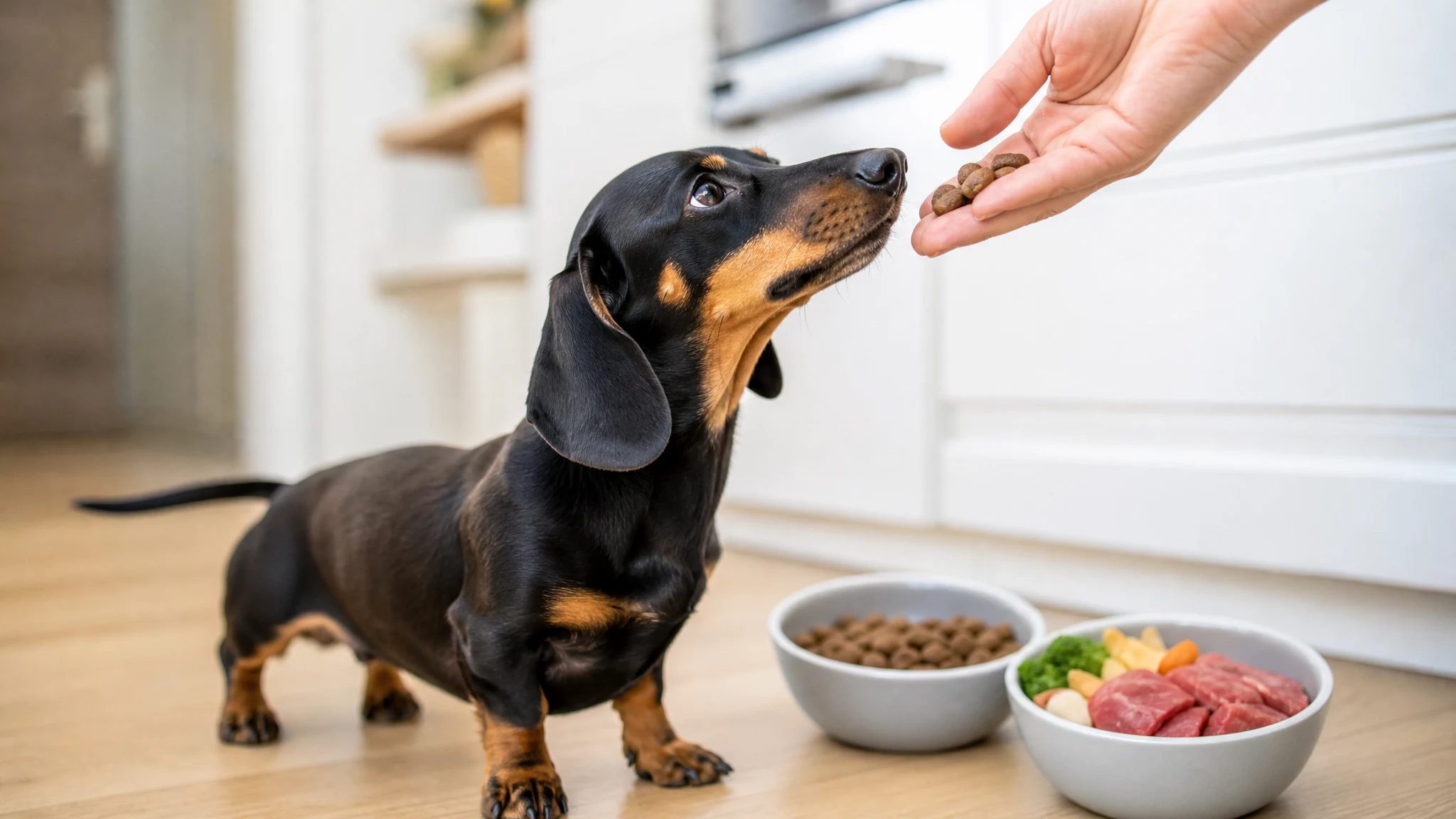
Dachshunds are food-motivated, clever and quick to figure out that a treat pouch means something good is coming. That makes treats a powerful training tool. It also makes them an easy way to add extra weight to a long, low dog.
This guide shows how to choose the best treats for Dachshunds, cut them to the right size, and count them so training does not crowd out balanced meals. The goal is simple: many small rewards, few extra calories.
A note on method. We did not taste-test or feed-test any treat. Everything here comes from published guidance and label-reading habits, not from our own trials.
Why treat choice matters for this breed
PetMD describes Dachshunds as predisposed to obesity and notes that excess weight raises the risk of back injury. The back matters because of intervertebral disc disease (IVDD). A review of canine chondrodystrophic disc disease in PubMed Central says Miniature Dachshunds are over-represented in Hansen type I IVDD. It also discusses obesity as a possible but unproven risk factor.
The evidence on weight and disc disease is mixed. The UK charity Dachshund Health cites Royal Veterinary College research linking heavier dogs to IVDD, but says its own 2015 survey did not find the same link. It still advises keeping Dachshunds lean.
None of this means a treat causes or prevents any condition. It means treats are worth counting. Your veterinarian can tell you what a healthy weight looks like for your individual dog.
Materials you will need
- A few treat types from the categories below, so you can match the reward to the task.
- A treat pouch or small container you can reach quickly.
- A small knife and cutting board, or kitchen scissors, for shrinking treats.
- Your dog's regular food, which can double as a reward.
- A kitchen scale or measuring cup, so you know what a day's food looks like.
- Your dog's daily calorie target from your veterinarian or from the feeding guide on the food label.
- A notepad or phone note to track treats for a week.
The three treat categories worth knowing
Soft training treats
Soft, moist treats are easy to tear into tiny pieces and are quick to swallow. That keeps training moving. They are useful for new skills and distracting places. Because they are often calorie-dense, cut them smaller than you think you need to.
Freeze-dried single-protein treats
These are made from one animal protein, such as one kind of meat. A short ingredient list is helpful if your dog has been told by a veterinarian to avoid a certain ingredient. They are strongly scented, which makes them good for high-value moments like recall practice. They crumble easily, so break them into flakes or pieces. Check the label for calories per piece or per serving, since the numbers vary widely.
Vegetables
Many owners use small pieces of dog-safe vegetables as low-calorie rewards. Common choices include green beans and carrot pieces. Not every dog likes them, and not every vegetable is safe for dogs. Ask your veterinarian which ones suit your dog, and introduce them slowly. Vegetables work best for easy, repeated tasks where you need many rewards.
You can also use part of your dog's own daily kibble as a reward. Measure the day's food, then set aside a share for training. That way the treats are already counted.
How to choose treats: a label-reading checklist
- Look for calories. Many treat labels list kilocalories (kcal) per treat or per serving. If a label does not, check the brand's own website or ask the brand.
- Read the ingredient list. Ingredients are listed by weight. Shorter lists make it easier to spot something your dog should avoid.
- Look for a nutritional statement. Many treats are labeled "for intermittent or supplemental feeding only." That tells you they are not a meal.
- Be skeptical of front-of-bag claims. Words like "natural" or "premium" do not tell you calories or size.
- Match texture to the job. Soft and smelly for hard jobs, simple and crunchy for easy ones.
For a broader look at the main meal, see our Dachshund foods compared by label data. Treats should sit on top of a complete and balanced diet, not replace one.
Step-by-step: how to treat-train a Dachshund
Step 1: Find your dog's daily calorie target
Start with your veterinarian. Ask how many calories your dog should eat each day and what body weight to aim for. The Dachshund Club of America breed standard describes standard Dachshunds as usually 16 to 32 pounds, and Miniatures as competing in the 11 pounds and under class at 12 months and older. Your own dog's ideal weight can differ, so use your veterinarian's number, not a breed average.
You can also check the feeding guide on your dog's food label. Treat it as a starting point, then adjust with your veterinarian's advice.
Step 2: Apply the 10 percent rule
The World Small Animal Veterinary Association (WSAVA) guidance commonly cited for treats is that they should make up no more than about 10 percent of a dog's daily calories. The rest should come from a complete and balanced diet. Confirm the right share for your dog with your veterinarian, especially for a puppy or a dog on a weight plan.
Here is the arithmetic, using made-up round numbers only. If a dog's daily plan were 400 kcal, 10 percent would be 40 kcal for all treats that day. That is not a target for your dog. Plug in your own number.
Step 3: Work out how many treats that allows
Find the kcal per treat on the label. Divide your daily treat allowance by that number. If a treat is large, cutting it in four also divides its calories by four, which gives you four rewards from one.
If you are training heavily on a given day, use less food at meals, or use the vegetable or kibble options. Treats count even when they feel small.
Step 4: Cut treats to the right size
A Dachshund has a small mouth and a small frame. For training, the reward should be gone in a swallow or two. A piece about the size of a pea or a small fingernail works for many dogs. Even smaller flakes are fine for repetitive drills.
Tiny pieces keep the session moving and stop your dog from stopping to chew. They also let you give far more rewards per session without going over your daily allowance.
Step 5: Reward right away, with calm timing
Use a marker word such as "yes" the instant your dog does the right thing. Then deliver the treat within a second or two. This reward-based approach is consistent with the American Veterinary Society of Animal Behavior (AVSAB) position that training should rely on rewards rather than punishment or fear.
Keep sessions short, around a few minutes, and end while your dog is still keen.
Step 6: Match the treat to the difficulty
Use vegetables or a few pieces of kibble for easy skills at home, like sit. Use soft treats for new skills. Save the strongly scented freeze-dried pieces for hard moments, such as coming when called outdoors.
Step 7: Track treats for a week
Write down what you give, including the bits from family members and any chew. At the end of the week, compare it with your allowance. Adjust meal portions if needed, and ask your veterinarian to check your dog's body condition at the next visit.
Step 8: Fade the treats slowly
Once a behavior is reliable, reward it every second or third time, at random. Add praise, a toy or a short game. Do not stop rewards abruptly, as the behavior may fade.
Tips for success
- Use a treat jar with a lid. Pre-counting the day's treats stops guesswork.
- Brief the household. Everyone should know the daily allowance, including children and visitors.
- Keep treats in rotation. A varied set keeps your dog interested without relying on one rich option.
- Introduce new treats one at a time. If your dog has loose stools or itching, you will know which food to ask your veterinarian about.
- Use the meal. On training-heavy days, take part of the dinner portion out and hand it over as rewards.
- Check chews and dental items too. They have calories and count toward the same allowance.
Common mistakes to avoid
- Treats that are too big. A whole biscuit is many rewards in one, and many calories for a small dog.
- Not counting treats. Small extras add up quickly in a small dog.
- Treating out of habit. Begging at the table or kitchen is not training. Reward behavior you asked for.
- Using treats as a bribe. Show the treat after the behavior, not before, or your dog learns to wait for the bribe.
- Swapping meals for treats. Treats are not complete and balanced. Their labels usually say so.
- Using human foods without checking. Some common foods are unsafe for dogs. Ask your veterinarian before offering something new.
- Ignoring the vet's advice. A dog with a health condition, allergy or weight plan may need a different treat approach.
What results to expect
With consistent, well-timed, tiny rewards, many Dachshunds learn simple behaviors such as sit, come and settle over a few weeks. Pace varies with age, the setting and the individual dog, and results are not guaranteed.
Keeping treats inside a daily allowance may help you maintain a steady body weight alongside balanced meals and exercise. That is a general feeding principle, not a promise about any health outcome. Treats do not prevent or treat back problems or any other disease. If you are worried about your dog's weight, mobility or back, talk with your veterinarian.
Puppies and seniors
Puppies need a complete and balanced growth diet, and treats should not crowd it out. General small-breed guidance from PetMD suggests adult size is reached at about 10 to 12 months, but it is not Dachshund-specific. Tufts advises that no puppy of any size move to adult food before 12 months, so confirm timing with your veterinarian. The same applies to treats: ask what is right for your puppy.
Older dogs may chew differently or need fewer calories. PetMD lists a typical lifespan of 12 to 16 years for the breed. Softer, smaller pieces can help, and your veterinarian can guide any change.
Quick recap
- Ask your veterinarian for your dog's daily calorie target.
- Cap treats at about 10 percent of daily calories, per WSAVA guidance.
- Read labels for kcal per treat and a short ingredient list.
- Cut everything to pea-sized pieces or smaller.
- Reward right after the behavior, using reward-based methods.
- Track a week of treats, adjust meals and fade rewards over time.