Best Dog Food for Dachshunds: Foods Compared by Label Data
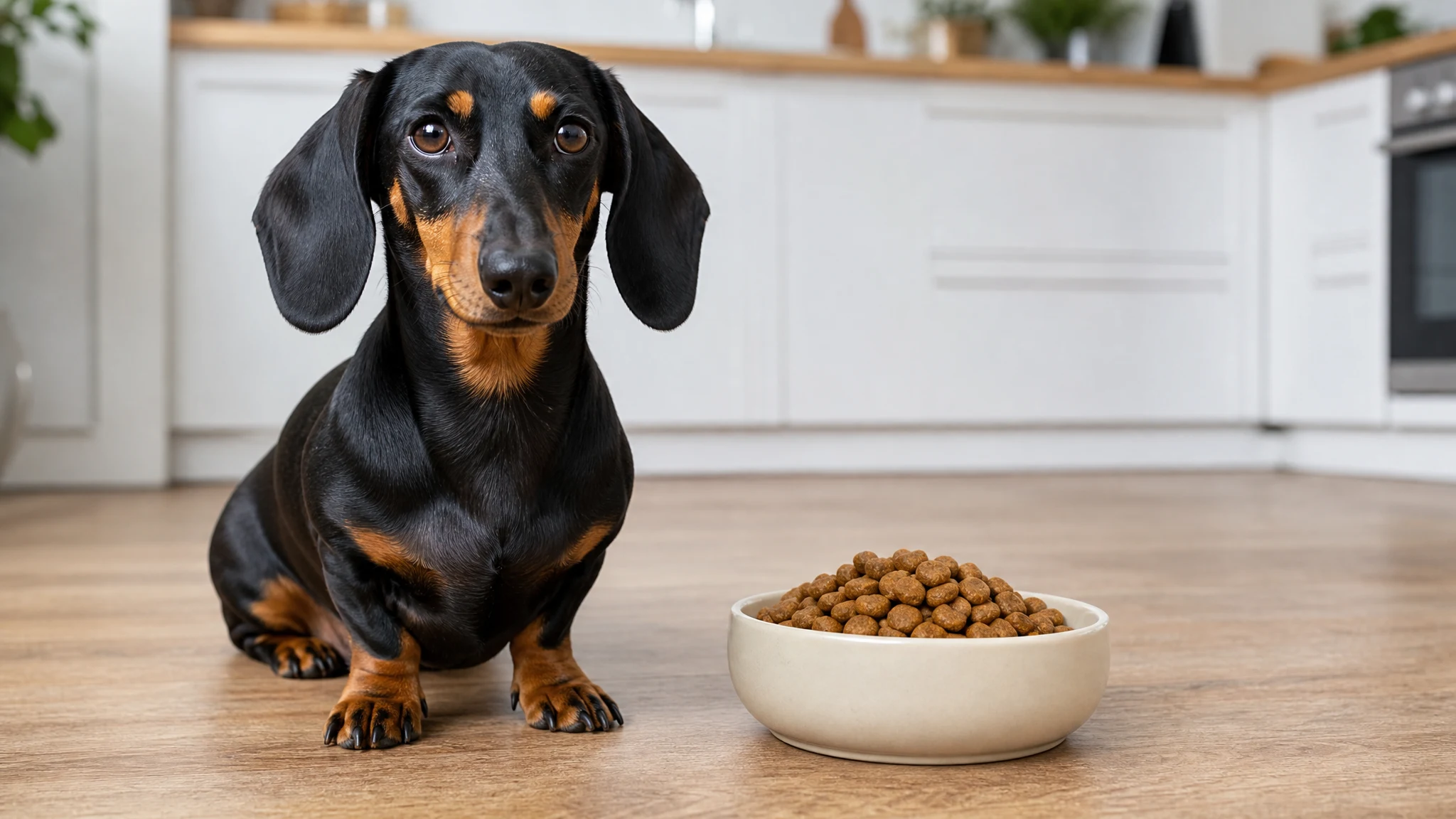
General nutrition information compiled from product labels and published sources, not veterinary advice. Your veterinarian is the right person to choose a diet for your dog, especially one with a health condition.
Choosing the best dog food for Dachshunds is harder than it looks. Marketing pages promise a lot, and the real information sits in small print on the label. This guide reads that print for you and lays it side by side.
It covers eight foods from four brands, sorted by situation: puppy, adult, senior, calorie-conscious, wet and fresh. It also covers the breed points that matter when you pick Dachshund food, and the red flags worth knowing.
How we compared these foods
We compared label data published by each brand. That means the AAFCO nutritional adequacy statement, the life stage, the guaranteed analysis (protein, fat and fiber), calories per cup, the first five ingredients and any kibble size information.
We did not run feeding trials. We did not do taste tests. We did not feed these foods to dogs. Nothing here says how a food performs in a real bowl, how it smells, or whether a particular dog likes it.
The foods are not ranked from best to worst. A label cannot tell you that. It can tell you what a food is designed for and what it contains, which helps you narrow the field before you talk to your veterinarian.
Two limits to keep in mind:
- We only compared foods whose label data we could confirm on the brand's own page. Many good foods are not on this list simply because we could not confirm their data.
- We list no prices. Prices change by store, bag size and region, and we will not guess. Check the brand and your local store.
Dachshund basics that shape food choice
Size
The Dachshund Club of America breed standard describes two sizes. Standards usually weigh 16 to 32 pounds. Miniatures compete in the class for 11 pounds and under at 12 months and older. Both are small dogs, well under the 70 pound line AAFCO uses for large-size dogs.
Weight and the back
PetMD describes Dachshunds as predisposed to obesity and says excess weight raises the risk of back injury. The evidence on intervertebral disc disease (IVDD) is more mixed than that sounds.
- A review of Hansen type I disc disease on PubMed Central notes that Miniature Dachshunds are over-represented, and discusses obesity as a possible but unproven risk factor.
- PetMD states that as many as 25% of Dachshunds develop IVDD in their lifetime.
- Dachshund Health UK, an IVDD charity, cites Royal Veterinary College research linking fat or obese dogs to IVDD. It also says its own 2015 survey did not replicate that finding, yet it still advises keeping Dachshunds lean.
No food prevents or treats disc disease. What the sources support is simple: portion control and a lean body condition are sensible goals, and your veterinarian decides what is right for an individual dog.
Lifespan and life stages
PetMD gives a typical lifespan of 12 to 16 years. That is a secondary source, so treat it as a rough range. A long life means several food decisions along the way, from puppy to adult to senior.
On the puppy-to-adult switch, PetMD gives general small-breed guidance (not Dachshund-specific): adult size at about 10 to 12 months, and readiness for adult food around 9 to 10 months. Tufts advises that no puppy of any size go onto adult food before 12 months. Because those two sources differ, confirm the timing with your veterinarian.
What to look for on a Dachshund food label
1. The AAFCO statement
This is the most useful line on the bag. It says whether the food is formulated to meet AAFCO nutrient profiles or has passed feeding tests, and for which life stage. Look for "growth," "maintenance" or "all life stages."
You will also see wording about large-size dogs (70 pounds or more as an adult). Tufts Cummings School's Petfoodology notes that AAFCO growth and all-life-stages labels must state either "including growth of large-size dogs" or "except for growth of large-size dogs." Tufts also notes that the calcium range is narrower for large and giant breed puppies. Dachshunds are not large-size dogs, so the "except for" wording is acceptable for them. A food that says "including" is also a complete option for a small puppy.
2. Life stage match
A puppy food, an adult food and a senior food are built for different needs. Match the food to your dog's stage, and ask your veterinarian when to change.
3. Calories per cup
For a breed where weight matters, calorie density is one of the most practical numbers on the label. Two cups of one food can differ a lot from two cups of another. Always check kcal per cup before you swap foods, and never pour the same volume of a new food as the old one without checking.
4. Protein and fat, on the right basis
Guaranteed analysis lists minimum protein and fat and maximum fiber "as fed." Some brands show only dry matter averages instead, which are higher because they remove water. The two are not directly comparable. We flag the difference below rather than convert numbers.
5. The first five ingredients
Ingredients are listed by weight before cooking, so the first few tell you the base of the food. Look at whether the list leads with a named meat, a meat meal or a by-product meal, and at the grain or starch sources behind it. This is a description, not a verdict. A meal or by-product meal is not automatically poor, and a fresh meat name first is not automatically better, since fresh meat contains a lot of water.
6. Kibble size
Dachshunds have long, narrow muzzles. Brands use phrases such as "small bites" or a shape designed for a small jaw. None of the brands in this guide gives a numeric kibble size, so the claim cannot be checked on paper. Watch how your own dog handles it.
The foods side by side
All data below is from each brand's own product page. "Unknown" means the page did not give the figure in a form we could confirm.
| Food | Form | Stage | Protein / fat / fiber | Calories |
|---|---|---|---|---|
| Royal Canin Dachshund Puppy | Dry | Growth (puppies 8 weeks to 10 months) | 28% min / 14% min / 3.9% max | 369 kcal ME per cup |
| Royal Canin Dachshund Adult | Dry | Maintenance (10 months and older) | 26% min / 12% min / 4.4% max | 293 kcal ME per cup |
| Royal Canin Dachshund Adult Loaf in Sauce | Wet | Maintenance | 7% min / 4.4% min / 2.1% max | 79 kcal ME per can |
| Hill's Science Diet Puppy Small & Mini Chicken & Brown Rice | Dry | Growth, plus gestation and lactation | Dry matter averages: 28.9% / 19.7% / 2.3% | 418 kcal per cup |
| Hill's Science Diet Adult Small Bites Chicken & Barley | Dry | Maintenance | Dry matter averages: 24% / 15.1% / 1.7% | 365 kcal per cup |
| Hill's Science Diet Adult 7+ Small Bites Chicken Meal, Barley & Rice | Dry | Maintenance, mature adult 7+ | Dry matter averages: 18.8% / 13.4% / 2.4% | 352 kcal per cup |
| Freshpet Small Dog Bite Size Chicken | Fresh | All life stages except growth of large-size dogs | 16% min / 12% min / 1.5% max | 267 kcal ME per cup |
| VICTOR Hi-Pro Plus Small Breed Adult | Dry | All life stages except growth of large-size dogs | 30% min / 14% min / 5% max | 360 kcal per cup |
| VICTOR Hi-Pro Plus Small & Medium Breed Puppy | Dry | All life stages except growth of large-size dogs | 30% min / 18% min / 5% max | 383 kcal per cup |
Do not compare the Hill's dry matter figures directly with the as-fed minimums for other brands, and do not compare dry foods with wet or fresh foods by percentages alone. Moisture changes the picture a great deal.
Top picks by situation
These are not endorsements and they are not ranked. Each entry says what the label shows and who it may suit.
Adult Dachshunds: Royal Canin Dachshund Adult
This is a Dachshund-specific dry food for purebred Dachshunds 10 months and older. The AAFCO statement is for maintenance. The first five ingredients are chicken by-product meal, brewers rice, brown rice, oat groats and wheat gluten. It is not grain free. The label lists 26% minimum protein, 12% minimum fat and 4.4% maximum fiber, at 293 kcal ME per cup (calculated, as fed).
The brand describes a small kibble shaped for a pointed muzzle, with no measurement given. The page offers a feeding table by weight and activity level and a feeding calculator.
It may suit owners who want a breed-targeted adult food with a comparatively low calorie count per cup. Note that 10 months is the brand's own cutoff, and your veterinarian may suggest waiting longer.
Adult Dachshunds, other label styles
Two other dry options show different profiles.
- Hill's Science Diet Adult Small Bites Chicken & Barley. The first five ingredients are chicken, cracked pearled barley, brown rice, brewers rice and whole grain wheat. Hill's states that animal feeding tests using AAFCO procedures substantiate complete and balanced nutrition for maintenance of adult dogs. The page gives 365 kcal per cup and dry matter averages of 24% protein and 15.1% fat. The kibble is described as small bite size, with no measurement. It is not labeled breed-specific.
- VICTOR Hi-Pro Plus Small Breed Adult. The first five ingredients are beef, chicken meal, beef meal, brown rice and whole grain millet. The label shows 30% minimum protein, 14% minimum fat, 5% maximum fiber and 360 kcal per cup. It is labeled for all life stages except growth of large-size dogs. The brand says to feed to maintain good body condition after age one, using the chart as a guide.
The VICTOR food has the highest minimum protein of the adult dry foods here. Higher protein is a label fact, not a quality grade, and whether it fits a given dog is a question for your veterinarian.
Puppies
Three puppy labels are available, all dry.
- Royal Canin Dachshund Puppy is for purebred Dachshunds from 8 weeks to 10 months. It is formulated for growth "including growth of large size dogs," which is a broader claim than a Dachshund needs but is not a problem. The first five ingredients are chicken by-product meal, brown rice, brewers rice, corn and wheat gluten. It lists 28% protein, 14% fat and 369 kcal ME per cup. The page has a feeding table by puppy age and target adult weight. As one example, a 2-month-old with a 6.6 lb target adult weight gets 5/8 cup (67 g) a day.
- Hill's Science Diet Puppy Small & Mini Chicken & Brown Rice starts with chicken, whole grain oats, brown rice, chicken meal and chicken fat. It has 418 kcal per cup, the highest of the dry foods here, with dry matter averages of 28.9% protein and 19.7% fat. The label is substantiated by AAFCO feeding tests for growing puppies and for gestating or lactating adult females. We could not confirm the complete AAFCO sentence, so read it on the Hill's page.
- VICTOR Hi-Pro Plus Small & Medium Breed Puppy starts with beef, chicken, beef meal, chicken meal and whole grain sorghum. It lists 30% protein, 18% fat and 383 kcal per cup. Its feeding note says to feed as much as the puppy will eat in 20 minutes, in four feedings a day. That differs from a measured portion, so ask your veterinarian whether it suits a breed that needs weight watched.
Puppy foods are calorie-dense by design. All three of these sit between 369 and 418 kcal per cup. Use the feeding guides as starting points and adjust with your veterinarian as your puppy grows.
Seniors: Hill's Science Diet Adult 7+ Small Bites
This is the only food in our set labeled for mature adults. The first five ingredients are chicken meal, cracked pearled barley, brewers rice, whole grain wheat and whole grain corn. The page gives dry matter averages of 18.8% protein, 13.4% fat and 2.4% crude fiber, and 352 kcal per cup. It is described as small bite size, with no measurement given.
Hill's says feeding amounts should be adjusted as necessary to maintain optimal weight, and to ask your veterinarian if unsure. Dachshunds are long-lived, so the 7+ stage can last years. A veterinarian can tell you whether a senior formula suits your dog or whether a standard adult food still does.
Calorie-conscious feeding
None of the foods here is labeled as a weight-management formula, and we make no claim that any of them controls weight. What the labels do show is calories per cup:
- Royal Canin Dachshund Adult: 293 kcal ME per cup
- Hill's Adult 7+ Small Bites: 352 kcal per cup
- VICTOR Hi-Pro Plus Small Breed Adult: 360 kcal per cup
- Hill's Adult Small Bites: 365 kcal per cup
A lower number per cup means a cup carries fewer calories, not that the dog will lose weight. The amount you feed matters more than the brand. If your dog needs to lose weight, that is a veterinary plan with a target, a measured portion and regular weigh-ins. A prescription weight diet is something only a veterinarian can prescribe.
Sensitive stomachs
None of the products in our set is labeled for digestive sensitivity, so we do not name a pick. Vomiting, loose stools or itching can have many causes that a label cannot sort out. Talk with your veterinarian before changing foods, and make any change gradually as the brand's page or your veterinarian suggests.
Wet food: Royal Canin Dachshund Adult Loaf in Sauce
This canned food is Dachshund-specific, with an AAFCO maintenance statement. The first five ingredients are water sufficient for processing, pork by-products, chicken by-products, chicken and pork liver. The label lists 7% minimum protein, 4.4% minimum fat and 2.1% maximum fiber. The page gives 79 kcal ME per can, as fed and calculated.
We could not confirm the can size, so check the brand's page before working out a daily amount. The feeding table on the page also has a first row that looks inconsistent, so verify amounts with the brand or your veterinarian rather than relying on one number.
Wet food is mostly water, which explains the low percentages. It may suit owners who want a softer texture, or who mix wet food with kibble. If you mix, count the calories of both.
Fresh food: Freshpet Small Dog Bite Size Chicken Recipe
This is a refrigerated fresh food for all life stages except growth of large-size dogs. The first five ingredients are chicken, chicken liver, carrots, cranberries and eggs. It is grain free. The label shows 16% minimum protein, 12% minimum fat, 1.5% maximum fiber and 267 kcal ME per cup (calculated).
The page uses a weight selector for daily amounts. Its example is 1 to 1 1/4 cups a day for an 11 to 15 pound dog. We could not confirm the exact wording of the AAFCO sentence, so read it on the Freshpet page.
A note on grain-free labels: the FDA has investigated a potential link between certain diets and canine dilated cardiomyopathy (DCM). Its latest update on that page is dated December 23, 2022, and the FDA says it does not plan more public updates until there is meaningful new scientific information. We make no claim in either direction. If grain-free versus grain-inclusive matters to you, ask your veterinarian.
Price points
A buyer's guide usually sorts picks into budget, mid-range and premium. We cannot do that honestly. Prices are not on the label, they vary by size and store, and we will not invent them.
Here is a more useful way to compare cost. Take the price of the bag and divide by the number of cups in it, then multiply by the cups your dog eats each day. A pricier food with fewer calories per cup is not necessarily more expensive per day than a cheaper, more calorie-dense one, because the amounts you feed differ.
Red flags to avoid
- No AAFCO statement. If the bag does not say it is complete and balanced for a stated life stage, it may be a treat or a supplement, not a main diet.
- Health claims. A food that says it prevents, treats or cures hip dysplasia, allergies, heart disease or bloat is making a claim a label should not make. Diet questions belong with your veterinarian.
- Breed-specific marketing with no data. A picture of a Dachshund is not nutrition. Check the same items on any bag: the AAFCO statement, calories per cup and ingredients.
- No calories per cup. Without it you cannot portion sensibly for a breed that gains weight easily.
- Vague feeding advice. "Feed as much as your dog will eat" is hard to square with weight control. Look for a chart you can measure against.
- Puppy food fed past the puppy stage without a plan. Puppy foods are more calorie-dense. Ask your veterinarian when to switch.
- Treating the ingredient list as a score. A long list of appealing words does not mean a better food. Read it with the AAFCO statement and the calories.
Where to buy
Each brand's own website has the current label data and feeding guide for every product, so start there. Product details change, and the brand page is the authority for the current formula.
You can then buy from a pet store, your veterinarian's clinic or an online seller. We do not link to retailers or recommend one. Whichever you use, check that the bag shows the same product name and life stage you intended, and look at the best-by date.
When you change foods, do it gradually, and watch your dog's weight and stool. Ask your veterinarian before changing the diet of a dog with a medical condition.
Putting it together
The best food for Dachshunds is the one that fits your dog's life stage, keeps your dog lean and is complete and balanced on its label. Beyond that, the choice is personal and medical, which is why a veterinarian should have the final say.
A short checklist:
- Match the AAFCO statement to your dog's life stage.
- Check calories per cup, and measure every meal.
- Compare protein and fat on the same basis (as fed or dry matter).
- Read the first five ingredients as a description of the food.
- Check the brand's own page for the current formula and feeding guide.
- Ask your veterinarian before switching, and about weight at every visit.
Sources
- Dachshund Club of America, breed standard
- PetMD, Dachshund Dog Breed Health and Care
- PetMD, When Should You Switch From Puppy to Adult Dog Food
- PubMed Central, Canine chondrodystrophic intervertebral disc disease (Hansen type I disc disease)
- Dachshund Health UK, Body Condition
- Tufts Cummings School, Petfoodology
- FDA CVM, Investigation into Potential Link between Certain Diets and Canine Dilated Cardiomyopathy
- Royal Canin, Dachshund Puppy Dry Dog Food
- Royal Canin, Dachshund Adult Dry Dog Food
- Royal Canin, Dachshund Adult Loaf in Sauce
- Hill's Science Diet, Puppy Small & Mini Chicken & Brown Rice
- Hill's Science Diet, Adult Small Bites Chicken & Barley
- Hill's Science Diet, Adult 7+ Small Bites
- Freshpet, Small Dog Bite Size Chicken Recipe
- VICTOR, Hi-Pro Plus Small Breed Adult
- VICTOR, Hi-Pro Plus Small & Medium Breed Puppy