Best Dog Food for Gut Health: Ranked by Label Data for Dachshunds
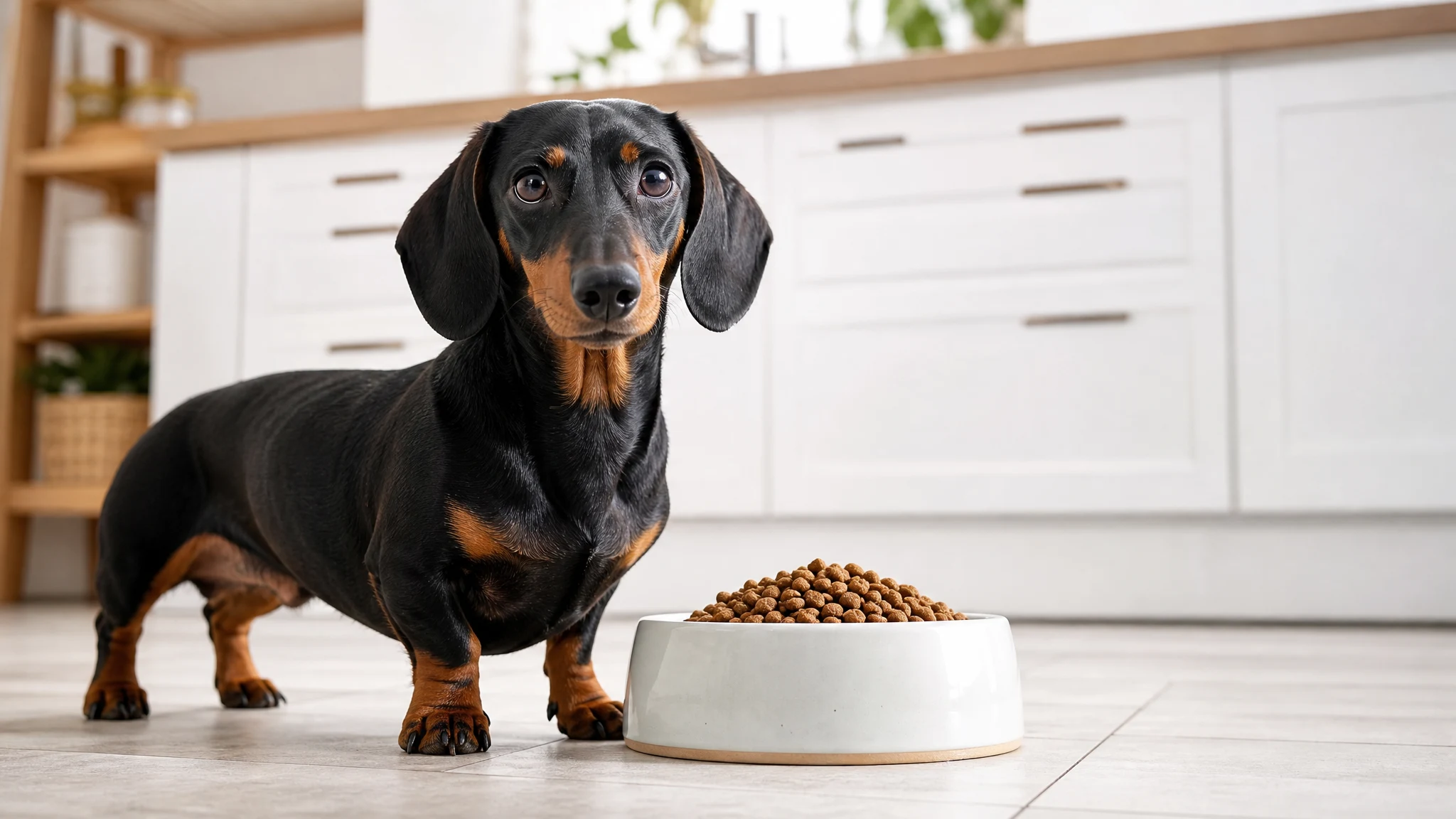
General nutrition information compiled from product labels and published sources, not veterinary advice. Your veterinarian is the right person to choose a diet for your dog, especially one with a health condition.
Every owner of a Dachshund with a touchy stomach wants the best dog food for gut health. A label cannot tell you how a food will sit in one dog's gut. It can tell you the life stage, the nutrient floor, the calories and the first ingredients. This guide shows how to use that data to build a short list, then switch foods in a careful way.
We compared label data only. We did not run feeding trials or taste tests, and nothing here says a food prevents or treats any condition.
What you need
- The bag or can of your current food, so you can read its label.
- Your Dachshund's age and a recent weight from your veterinarian.
- A kitchen scale or a marked measuring cup.
- A notebook or phone note for stool quality, appetite and energy.
- Your veterinarian's phone number, since any ongoing stomach trouble needs a vet visit.
Step 1: Settle the basics with your vet first
Loose stools, vomiting or gas that keeps coming back can have many causes. A food change will not sort that out by itself. Ask your veterinarian to rule out medical causes before you shop. If a special diet is needed, a prescription diet is something only a veterinarian prescribes.
Dachshunds come in two sizes. The Dachshund Club of America breed standard describes standard Dachshunds as usually 16 to 32 lb. It lists miniatures in the 11 lb and under class at 12 months and older. Both are small dogs, so small-breed and Dachshund-specific formulas are the natural place to start.
Step 2: Match the life stage
The AAFCO statement on the label says which life stage a food is made for. For a Dachshund, check three wordings:
- Growth: for puppies.
- Maintenance: for adults.
- All life stages: works for any age, but read the large-dog line.
AAFCO growth and all-life-stages labels must say either "including" or "except for" growth of large-size dogs (70 lbs or more as an adult). Tufts Cummings School's Petfoodology blog notes the calcium range is narrower for large and giant breed puppies. Dachshunds are not large-size dogs, so the "except for" wording is acceptable for them.
On puppy timing, PetMD gives general small-breed guidance of adult food at about 9 to 10 months. That is not Dachshund-specific. Tufts advises that no puppy of any size move to adult food before 12 months. Confirm the date with your vet.
Step 3: Compare label data side by side
Here is how the foods in our comparison line up. Royal Canin, VICTOR and Freshpet list minimum protein and fat as fed. Hill's lists only dry matter averages on the pages we compared, so those numbers are not directly comparable to the others. Check the brand page for current label data, because formulas change.
Adult foods
| Food | AAFCO life stage | Protein / fat | Calories | First ingredients |
|---|---|---|---|---|
| Royal Canin Dachshund Adult (dry) | Maintenance | 26% min / 12% min | 293 kcal ME per cup | Chicken by-product meal, brewers rice, brown rice, oat groats, wheat gluten |
| Hill's Science Diet Adult Small Bites Chicken & Barley | Maintenance (feeding tests) | 24% / 15.1% (dry matter averages) | 365 kcal per cup | Chicken, cracked pearled barley, brown rice, brewers rice, whole grain wheat |
| Hill's Science Diet Adult 7+ Small Bites | Maintenance (feeding tests) | 18.8% / 13.4% (dry matter averages) | 352 kcal per cup | Chicken meal, cracked pearled barley, brewers rice, whole grain wheat, whole grain corn |
| VICTOR Hi-Pro Plus Small Breed Adult | All life stages except large-size growth | 30% min / 14% min | 360 kcal per cup | Beef, chicken meal, beef meal, brown rice, whole grain millet |
| Freshpet Small Dog Bite Size Chicken (fresh) | All life stages except large-size growth | 16% min / 12% min | 267 kcal per cup | Chicken, chicken liver, carrots, cranberries, eggs |
| Royal Canin Dachshund Adult Loaf in Sauce (canned) | Maintenance | 7% min / 4.4% min | 79 kcal ME per can | Water, pork by-products, chicken by-products, chicken, pork liver |
Puppy foods
| Food | AAFCO life stage | Protein / fat | Calories | First ingredients |
|---|---|---|---|---|
| Royal Canin Dachshund Puppy (dry) | Growth, including large size dogs | 28% min / 14% min | 369 kcal ME per cup | Chicken by-product meal, brown rice, brewers rice, corn, wheat gluten |
| Hill's Science Diet Puppy Small & Mini Chicken & Brown Rice | Growth (feeding tests) | 28.9% / 19.7% (dry matter averages) | 418 kcal per cup | Chicken, whole grain oats, brown rice, chicken meal, chicken fat |
| VICTOR Hi-Pro Plus Small & Medium Breed Puppy | All life stages except large-size growth | 30% min / 18% min | 383 kcal per cup | Beef, chicken, beef meal, chicken meal, whole grain sorghum |
For a longer side-by-side, see our Dachshund foods compared by label data.
Step 4: Rank the short list for your dog
Here is how we would order the list, using label data alone. This order says which foods fit a Dachshund's size and life stage on paper. It does not say which food will give your dog the best gut results.
- Right life stage and size first. Royal Canin's Dachshund formulas are the only breed-specific ones here. Their label says the kibble shape is designed for a Dachshund's muzzle and jaw. The Hill's and VICTOR small-breed foods are the size-matched options.
- A short, readable ingredient panel. Pick foods whose first five ingredients you understand. If your dog has reacted badly to an ingredient before, skip foods that list it up front.
- Calories you can manage. Calories per cup range from 267 (Freshpet) to 365 (Hill's Adult Small Bites) among the adult dry and fresh foods. A small dog's daily amount is small, so a few extra kcal per cup add up fast.
- Protein and fat that suit your dog. A higher-fat food is not a problem for every dog, but rich foods are a common reason owners see loose stools. Ask your vet whether the fat level suits your dog.
Fiber is the one gut-related number on the label. The label gives a maximum, not a target. Among the foods above, Royal Canin Adult lists 4.4% max, VICTOR lists 5.0% max and Freshpet lists 1.5% max. The Hill's pages we compared give only dry matter averages of 1.7% to 2.4%. These figures describe a food. They do not show that it is better for digestion.
We did not find any gut-health claim, probiotic content or digestibility figure in the label data we compared. If a brand's marketing makes one, ask the brand for the evidence.
Step 5: Set a starting amount
Use the feeding guide on the brand's page as a starting point only. Hill's pages say to adjust amounts as necessary to maintain optimal weight. Weigh your dog every few weeks and adjust with your vet.
Weight matters for Dachshunds. PetMD says the breed is predisposed to obesity and that extra weight raises the risk of back injury. Research on intervertebral disc disease (IVDD) is mixed. A review in PubMed Central says miniature Dachshunds are over-represented in Hansen type I disc disease and calls obesity a possible but unproven risk factor. Dachshund Health UK still advises keeping Dachshunds lean. Your vet can score your dog's body condition.
Step 6: Switch foods slowly
A sudden swap is a common cause of an upset stomach. A gradual change gives your dog's gut time to adjust.
- Start with mostly the old food and a small share of the new one.
- Raise the new food's share every few days if stools stay normal.
- Finish on the new food alone. Some dogs need a longer switch than others, so ask your vet for a schedule.
- Keep treats and table scraps steady during the switch, so you know what caused any change.
Tips
- Change one thing at a time. Do not swap food, treats and chews in the same week.
- Keep a short daily log of stool, appetite and energy.
- Measure every meal. Do not scoop by eye.
- Count treats in the daily calories.
Common mistakes to avoid
- Treating a label as proof. Label data shows what is in the bag, not how your dog will react.
- Buying by grain-free or ingredient trends. All the foods above are listed as grain inclusive except Freshpet. The FDA's page on its investigation into diets and canine dilated cardiomyopathy (DCM) was last updated December 23, 2022, and the agency said it does not plan further public updates until there is meaningful new scientific information. Talk to your vet about grain-free choices.
- Moving a puppy to adult food too soon. See Step 2.
- Quoting the wrong can size. Royal Canin's canned label lists calories per can, and the page we compared did not confirm can size. Check the can before you calculate amounts.
- Waiting too long to call the vet. Persistent diarrhea, vomiting, blood in stool or lethargy need a vet visit, not another food trial.
What to expect
A well-matched food, a slow switch and steady portions may help your dog's stools stay consistent. Results vary a lot from dog to dog. Some dogs settle in a week or two. Others never need a change at all.
If stools are still off after a few weeks on a steady diet, call your veterinarian. They can decide whether a different food, a test or a prescription diet is right for your dog.
Sources
- Dachshund Club of America, breed standard
- Tufts Cummings School, Petfoodology
- PetMD, Dachshund Dog Breed Health and Care
- PetMD, When Should You Switch From Puppy to Adult Dog Food
- PubMed Central, Canine chondrodystrophic intervertebral disc disease (Hansen type I disc disease)
- Dachshund Health UK, Body Condition
- FDA CVM, Investigation into Potential Link between Certain Diets and Canine Dilated Cardiomyopathy
- Royal Canin Dachshund Adult, Dachshund Puppy and Dachshund Loaf in Sauce
- Hill's Adult Small Bites, Adult 7+ Small Bites and Puppy Small & Mini
- VICTOR Hi-Pro Plus Small Breed Adult and Small & Medium Breed Puppy
- Freshpet Small Dog Bite Size Chicken Recipe