Best Puppy Food for Dachshund Puppies
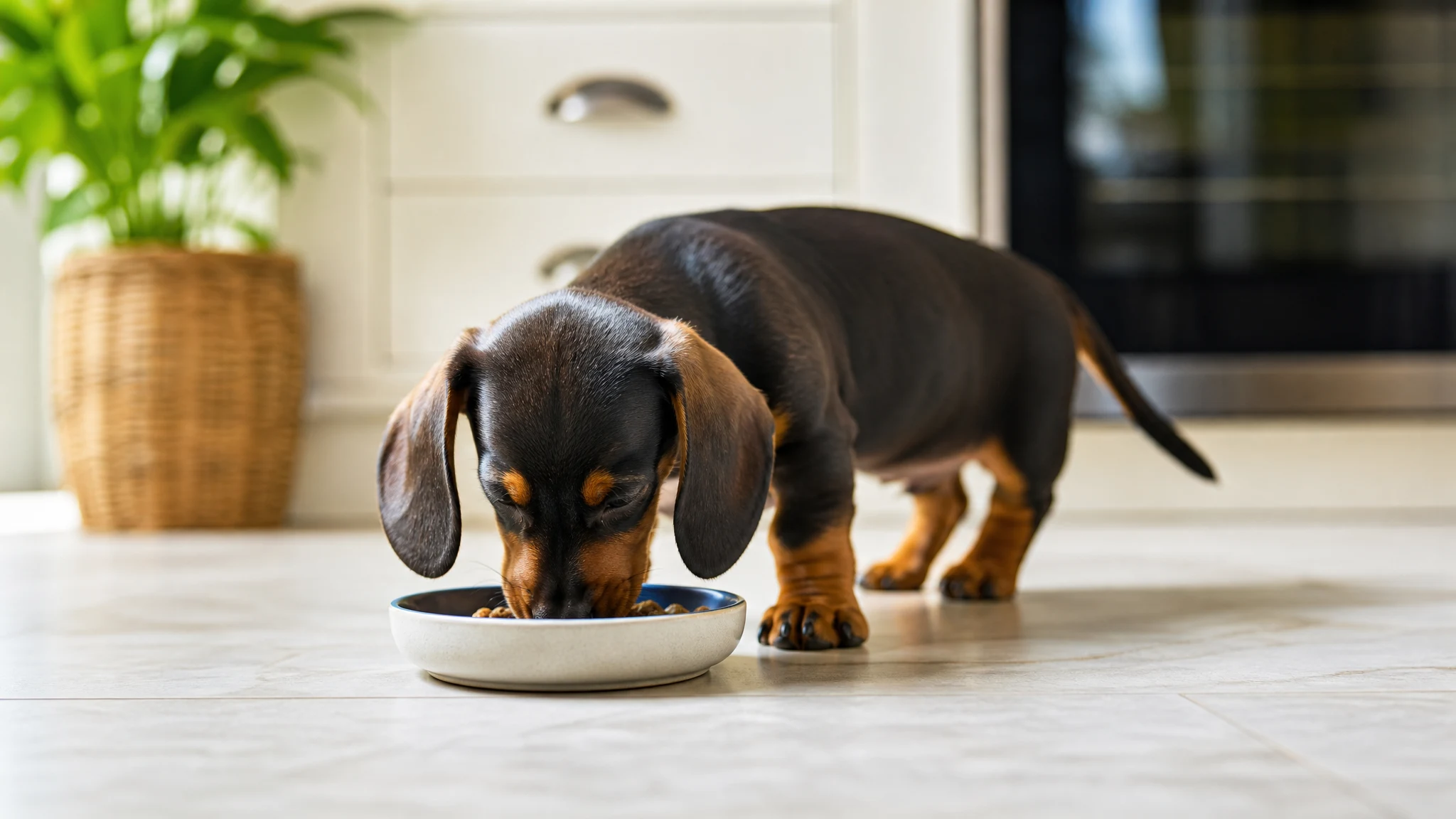
General nutrition information compiled from product labels and published sources, not veterinary advice. Your veterinarian is the right person to choose a diet for your dog, especially one with a health condition.
Choosing dachshund puppy food is mostly an exercise in reading labels. Marketing pages promise a lot. The label tells you what the food is formulated to do, what is in it and how many calories it packs into each cup.
This guide explains what to check when you look for the best puppy food for Dachshunds, compares four puppy-appropriate formulas by their published label data, and covers feeding schedules and when to move to adult food. We compared label data from the brands' own pages. We did not run feeding trials or taste tests, so nothing here is a claim about how a food performs in a real dog.
First, what makes a Dachshund puppy different
The Dachshund Club of America breed standard describes two sizes. Standard Dachshunds are usually 16 to 32 pounds. Miniatures compete in the 11 pounds and under class at 12 months and older. Both are small dogs, well under the 70 pound line that pet food labels use to define large-size dogs.
That matters for the label. Growth and all-life-stages foods must say either that they cover the growth of large-size dogs (70 pounds or more as an adult) or that they do not. Tufts Cummings School's Petfoodology blog notes that the calcium range is narrower for large and giant breed puppies. A Dachshund is not a large-size dog, so a food that says "except for growth of large-size dogs" is an acceptable match. A food that includes large-size growth is also fine.
Weight is the other breed-specific point. PetMD describes Dachshunds as predisposed to obesity and says excess weight raises the risk of back injury. The research on weight and disc disease is less settled. A review of Hansen type I disc disease in PubMed Central says miniature Dachshunds are over-represented and discusses obesity as a possible but unproven risk factor. A UK Dachshund disc disease charity, Dachshund Health UK, says its own 2015 survey did not replicate earlier research linking heavier dogs to disc disease, yet it still advises keeping Dachshunds lean.
No food prevents or treats disc disease. What you can do is pick a complete puppy food and measure portions carefully. Your veterinarian decides what is right for your individual puppy.
What to look for on a puppy food label
1. A growth statement from AAFCO
This is the first filter. Look for a sentence saying the food is formulated to meet the AAFCO Dog Food Nutrient Profiles for growth, or for all life stages. A maintenance-only statement means the food is meant for adults. Skip it for a puppy.
2. How the statement is substantiated
Some labels say the food was formulated to meet the profiles. Others say animal feeding tests using AAFCO procedures substantiate it. Both are legitimate routes. Neither tells you which food your puppy will do best on.
3. Calories per cup
Small dogs eat small amounts, so calorie density shapes how far a cup goes. A richer food needs smaller portions. For a breed that gains weight easily, knowing the kcal per cup lets you measure sensibly instead of guessing.
4. Ingredients in order
Ingredients are listed by weight before cooking. That favors fresh meats, which are heavy with water, over dry ingredients. A first ingredient of chicken and a first ingredient of chicken meal are not directly comparable. The ingredient list helps you spot something your puppy has reacted to before. It is not a quality score.
5. Guaranteed analysis, read carefully
Protein and fat are minimums. Fiber is a maximum. Wet and fresh foods contain a lot of water, so their percentages look low next to kibble. Compare like with like. Some brands publish only dry matter averages, which are not the same as the as-fed minimums on a bag.
6. Kibble size and shape
Dachshunds have a long, narrow muzzle and small mouths. Brands describe small or breed-shaped kibble, but none of the pages we compared gives a numeric size. Check how your puppy handles the pieces.
Puppy foods compared by label data
Four products in our research have a growth or all-life-stages statement. All figures come from the brands' own product pages. We have no price data, so we are not ranking by cost.
| Food | Form | Growth statement | Protein / fat / fiber | Calories |
|---|---|---|---|---|
| Royal Canin Dachshund Puppy | Dry | Growth, including large-size dogs | 28% min / 14% min / 3.9% max | 369 kcal ME per cup |
| Hill's Science Diet Puppy Small & Mini Chicken & Brown Rice | Dry | Growing puppies, by AAFCO feeding tests | Dry matter averages only: 28.9% / 19.7% / 2.3% | 418 kcal per cup |
| VICTOR Hi-Pro Plus Small & Medium Breed Puppy | Dry | All life stages, except large-size growth | 30% min / 18% min / 5% max | 383 kcal per cup |
| Freshpet Small Dog Bite Size Chicken | Fresh | All life stages, except large-size growth | 16% min / 12% min / 1.5% max | 267 kcal per cup |
The Freshpet figures are for a fresh food with high moisture, so its percentages are not directly comparable with the dry foods. Its calories per cup are lower partly for the same reason.
Top picks by type of food
We cannot give honest price tiers because we have no verified prices. Instead, here are the four options grouped by what kind of buyer each suits. Check each brand's page for current pricing and availability.
Best breed-specific option: Royal Canin Dachshund Puppy
This is the only formula in our research made specifically for Dachshunds. Royal Canin says it is for purebred Dachshunds from 8 weeks to 10 months old. The AAFCO statement covers growth, including growth of large-size dogs. The first five ingredients are chicken by-product meal, brown rice, brewers rice, corn and wheat gluten. It contains grain.
The brand describes a small, customized kibble shape for the breed's pointed muzzle and small jaw. It gives no measurement. Its feeding table is organized by puppy age and expected adult weight. One example on the page: a 2-month-old puppy with a 6.6 pound target adult weight gets 5/8 cup (67 g) a day. That target is smaller than a typical Dachshund, so use the table row that matches your own puppy's expected adult size, and ask your breeder or veterinarian if you are unsure. See the Royal Canin Dachshund Puppy page.
Best for a small-breed puppy with meat-first ingredients: Hill's Science Diet Puppy Small & Mini
The first five ingredients are chicken, whole grain oats, brown rice, chicken meal and chicken fat. Hill's says animal feeding tests using AAFCO procedures substantiate that it provides complete and balanced nutrition for growing puppies. We captured only part of the full label sentence, so read the whole statement on the brand's page before relying on it.
At 418 kcal per cup, it is the most calorie-dense food in this comparison, which means smaller portions. Hill's lists protein and fat only as dry matter averages, and gives no kibble size. Its feeding guidance says to adjust amounts as necessary to maintain optimal weight. See the Hill's Science Diet Puppy Small & Mini page.
Highest protein and fat on paper: VICTOR Hi-Pro Plus Small & Medium Breed Puppy
VICTOR lists 30% minimum protein and 18% minimum fat. Its AAFCO statement covers all life stages except growth of large-size dogs, which suits a Dachshund. The first five ingredients are beef, chicken, beef meal, chicken meal and whole grain sorghum, and the calories are 383 per cup.
Higher fat means more calories in each bite, so watch portions closely with a breed that gains weight easily. VICTOR says to feed as much as the puppy will eat in 20 minutes, in four feedings spaced through the day. For a Dachshund, ask your veterinarian whether that suits your puppy, since the brand's guidance is a starting point and not a tailored plan. See the VICTOR Small & Medium Breed Puppy page.
Best fresh option to consider: Freshpet Small Dog Bite Size Chicken Recipe
This is a fresh food, not kibble. The first five ingredients are chicken, chicken liver, carrots, cranberries and eggs. It is listed as grain free. Its statement covers all life stages with an exception for growth of large-size dogs. We paraphrased part of that wording, so confirm the exact sentence on the brand's page.
Calories are 267 per cup, with 16% minimum protein and 12% minimum fat. Because it is fresh, check the brand's page for storage and handling instructions. On grain-free diets in general, the FDA's investigation into a possible link between certain diets and canine dilated cardiomyopathy has not been updated since December 23, 2022. The agency said it does not plan further public updates until there is meaningful new scientific information. If you have questions about grain-free feeding, ask your veterinarian. See the Freshpet Small Dog Bite Size page.
Feeding frequency and portions
Young puppies eat small meals several times a day. VICTOR's puppy guidance uses four feedings spaced through the day. That is one real example, not a rule for every puppy. Your breeder or veterinarian can tell you how often to feed at each age.
Start with the label's feeding table for your puppy's age and expected adult weight. Treat it as a starting point. Then watch body condition. You should be able to feel the ribs under a light covering, and your puppy should have a visible waist. If you are unsure, ask your veterinarian to show you how to score body condition at the next visit.
Measure with a proper measuring cup or a kitchen scale. Eyeballing portions is how small dogs gain weight. Count treats toward the day's total.
We could not find a breed-specific growth chart or a Dachshund-specific growth guide from a primary source. For growth targets and weight checks, ask your veterinarian or the breeder.
When to switch to adult food
General small-breed guidance, reported by PetMD, puts adult size at about 10 to 12 months, with some small dogs ready for adult food at 9 to 10 months. That is general guidance for dogs under 25 pounds, not Dachshund-specific. Tufts advises that no puppy of any size go onto adult food before 12 months.
Royal Canin's Dachshund puppy formula is labeled for dogs up to 10 months, and its adult Dachshund formula starts at 10 months. Because these sources differ, confirm timing with your veterinarian. Make any switch gradually over several days by mixing increasing amounts of the new food with the old, and watch stools and appetite.
Red flags to avoid
- No AAFCO statement, or a maintenance-only statement. A food for adult maintenance is not a puppy food.
- Claims that a food prevents or cures a condition. Pet food labels and websites should not promise to treat hip, back, skin or heart problems. Be skeptical if one does.
- "Premium" or "holistic" with nothing behind it. These words have no set meaning on a label.
- No calorie information. If you cannot find kcal per cup, you cannot portion accurately.
- Treating ingredient lists as a ranking. A longer list of appealing ingredients is not proof of a better food.
- Home-made or raw feeding plans without professional guidance. Growing puppies have exact nutrient needs. Ask a veterinarian before leaving a complete puppy food.
- Large-breed puppy formulas by default. A Dachshund is not a large-size dog, so "including growth of large-size dogs" is not required for your puppy.
- Prescription diet claims from a bag you picked up yourself. Prescription diets are something a veterinarian prescribes for an individual dog.
Where to buy
Each brand lists its products on its own website, and each page above links to the maker's product page. We do not link to retailers. Use the brand's page to confirm the exact product name and formula, then check with the brand or your local pet store for availability and current pricing.
Before buying, check the bag for the full AAFCO statement, the calories per cup and the date code. Stick with one food while your puppy settles in, so you can tell if a change in stool or appetite comes from the diet.
How to decide
Start with the growth statement. Then compare calories per cup, ingredients and how the brand describes its feeding guide. Pick a food your puppy likes and tolerates, measure portions, and keep your Dachshund lean as they grow. Bring the bag or the label to your veterinarian and ask if it fits your puppy.
Sources
- Dachshund Club of America, breed standard
- PetMD, Dachshund Dog Breed Health and Care
- PetMD, When Should You Switch From Puppy to Adult Dog Food
- Tufts Cummings School, Petfoodology
- PubMed Central, Canine chondrodystrophic intervertebral disc disease (Hansen type I disc disease)
- Dachshund Health UK, Body Condition
- FDA CVM, Investigation into Potential Link between Certain Diets and Canine Dilated Cardiomyopathy
- Royal Canin, Dachshund Puppy Dry Dog Food
- Hill's Pet, Science Diet Puppy Small & Mini
- VICTOR, Hi-Pro Plus Small & Medium Breed Puppy
- Freshpet, Small Dog Bite Size Chicken Recipe